




How to Fix the 'Fishbowl Effect' in High Prescription Lenses
Summary
The "fishbowl effect" is a common optical distortion experienced by high-prescription users where peripheral vision appears warped, curved, or "swimming." This phenomenon is primarily caused by spherical aberration and prismatic effects at the edges of high-power lenses. To fix or minimize this effect in 2026, users should prioritize aspheric lens designs, select high-index materials like 1.74 to reduce edge thickness, and ensure precise frame fitting that optimizes vertex distance and optical center alignment.

Disclaimer: This guide provides general optical and dispensing information and is not a substitute for professional medical advice, diagnosis, or treatment. Always consult with a licensed optometrist or optician for personalized vision care.
Key Takeaways
- Aspheric Design is Essential: Unlike traditional spherical lenses, aspheric designs utilize a non-spherical surface profile to significantly reduce peripheral distortion and the "bug-eye" or "shrunken-eye" look.
- Material Matters: Utilizing high-index materials (1.67 or 1.74) allows for flatter base curves and thinner edges, which directly mitigates the prismatic effects that cause the fishbowl sensation.
- Frame Geometry Impacts Clarity: Smaller, rounder frames with a narrow lens diameter are superior for high prescriptions as they cut away the most distorted outer portions of the lens blank.
- Precision in Fitting: Accurate measurements of Pupillary Distance (PD) and Optical Center (OC) height are critical; even a 1-2mm deviation can induce unwanted prism and exacerbate "swimming" visuals.
- Adaptation is Normal: Most users require a 3-to-7-day adaptation period for their brain to recalibrate to new high-index optics, especially when switching from spherical to aspheric designs.
Understanding the Optical Mechanics of the Fishbowl Effect
When you put on a new pair of high-prescription glasses and feel like you are looking through a glass bowl, you are experiencing a combination of optical phenomena. For those with high myopia (nearsightedness) or hyperopia (farsightedness), the lenses required to correct vision must be significantly curved. This curvature creates a discrepancy in how light is refracted at the center of the lens versus the periphery.
In high-minus lenses, the edges are thicker, leading to "barrel distortion" where straight lines appear to curve outward. Conversely, high-plus lenses are thicker in the center, causing "pincushion distortion" where lines curve inward. These effects are compounded by spherical aberration—the inability of a spherical lens to focus light rays from the periphery onto the same focal point as rays from the center. In 2026, while lens technology has advanced, these fundamental physics remain the primary challenge for high-diopter corrections.
Expert Insight: The fishbowl effect is an inherent byproduct of lens geometry in high-power prescriptions. Mitigation strategies focus on altering the lens shape (asphericity) or the material (refractive index) to minimize the physical curvature required for correction.
The Role of Aspheric Lens Design in Reducing Distortion
One of the most effective technical solutions for the fishbowl effect is the transition from spherical to aspheric lens geometry. Standard spherical lenses have a surface that follows the curve of a ball. While simple to manufacture, they are inefficient at managing light rays that enter at an angle through the periphery.
Aspheric lenses, however, feature a complex, flatter surface profile that gradually changes from the center to the edge. This design allows the lens to provide the same refractive power with significantly less curvature. By flattening the lens, aspheric designs eliminate much of the peripheral spherical aberration. Furthermore, aspheric lenses are thinner and lighter, which reduces the magnification (in plus lenses) or minification (in minus lenses) of the wearer's eyes, providing a more natural appearance.

High-Index Materials: 1.67 vs. 1.74
The refractive index of a lens material determines how efficiently it bends light. A higher index means the material can achieve the same prescription with less physical mass. For users with prescriptions exceeding +/- 4.00 diopters, moving to high-index materials is a standard recommendation to combat distortion.
The technical specifications of high-index lens materials highlight that materials like the MR™ series polymers (1.67 and 1.74) offer a superior balance of thinness and optical clarity. While 1.67 high-index lenses are excellent for mid-to-high prescriptions, users with very high diopters often benefit most from 1.74 super high-index lenses, which are the thinnest plastic lenses currently available.
| Feature | 1.61 High-Index | 1.67 High-Index | 1.74 Super High-Index |
|---|---|---|---|
| Prescription Range | +/- 3.00 to +/- 5.00 | +/- 5.00 to +/- 7.00 | +/- 7.00 and above |
| Thickness Reduction* | ~20% vs. Standard | ~35% vs. Standard | ~50% vs. Standard |
| Abbe Value (Clarity) | 36-41 | 32 | 33 |
| Best For | Moderate correction | High correction | Extreme correction |
*Note: Thickness reduction percentages are typical manufacturer estimates based on a standard 50mm lens diameter and may vary by +/- 5% depending on frame shape and prescription.
When choosing between these, consider the comparison of 1.67 vs. 1.74 high-index lenses. While 1.74 is thinner, 1.67 sometimes offers a slightly higher Abbe value, which relates to less chromatic aberration (color fringing). However, for the specific goal of fixing the fishbowl effect, the thinner profile of 1.74 usually wins by allowing for a flatter base curve.
Optimizing Frame Selection and Fitting Parameters
Even the most advanced 1.67 high-index lenses can fail if paired with the wrong frame. Frame selection is perhaps the most underrated factor in eliminating peripheral distortion.
Visual Comparison: The Impact of Frame Size
To visualize the improvement, consider a -6.00D prescription. In a large, 55mm rectangular frame, the edge thickness of a standard lens might reach 7.0mm, creating significant "barrel distortion." By switching to a 48mm round frame and 1.74 high-index material, that edge can be reduced to approximately 3.8mm. This reduction removes the most distorted peripheral zones of the lens, effectively "cutting out" the fishbowl effect.
The Importance of Lens Diameter
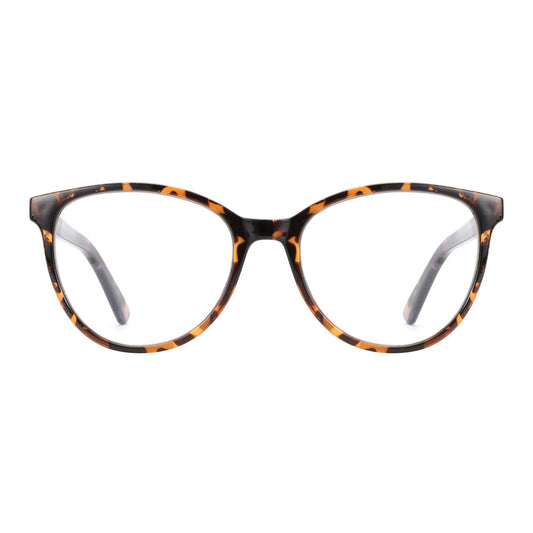
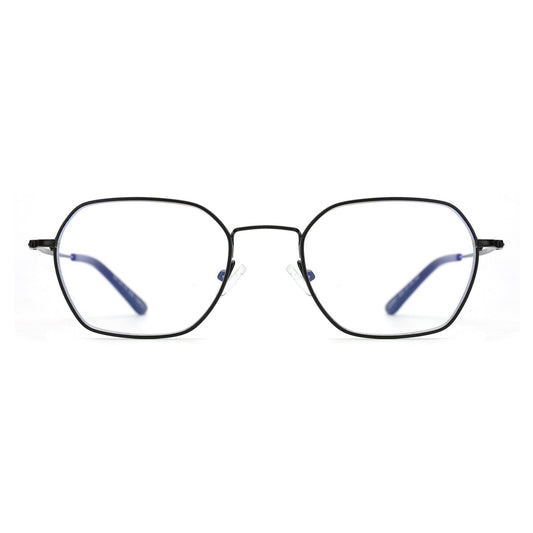
The further a lens extends from your pupil, the more distortion is present. Large "oversized" frames are the primary enemy of high-prescription clarity. By selecting a frame with a smaller lens diameter, the lab cuts away the outer edges of the lens blank—the very area where the fishbowl effect is most pronounced. Round or oval shapes are generally better than square or rectangular ones because they avoid the thick, distorted corners.
Vertex Distance and Pantoscopic Tilt
Vertex distance is the space between the back of the lens and the front of your cornea. For high prescriptions, an optimal vertex distance is typically between 12mm and 14mm. If the glasses sit too far from your face, the magnification or minification effect increases, worsening the "swimming" sensation. Proper glasses fitting techniques ensure that the frame sits close to the eyes without touching the lashes.
Additionally, pantoscopic tilt—the inward angle of the frame front toward the cheeks—should be adjusted to ensure the wearer's line of sight is perpendicular to the lens surface. Incorrect tilt induces "marginal astigmatism," a type of distortion that mimics the fishbowl effect.
Measurement Accuracy: PD and OC Height
Precision measurements are the foundation of high-prescription success. When choosing frames for high prescriptions, you must ensure your Pupillary Distance (PD) is measured accurately. In 2026, digital measuring tools have become standard, but the principle remains: the optical center of the lens must sit directly in front of your pupil.
For high-index lenses, especially aspheric ones, the vertical placement—known as the Optical Center (OC) height—is just as important as the horizontal PD. If the OC height is off by even 2mm, the wearer will be looking through a portion of the lens that induces "prismatic effect," causing objects to appear shifted from their true position and contributing to a dizzying fishbowl sensation.
Adaptation Period and Troubleshooting
It is a common pattern that new glasses do not feel perfect immediately. In reality, the brain needs time to adapt to a new "visual map." This is especially true if you are switching from a lower index to a higher index, or from a spherical to an aspheric design.
- The 3-Day Rule: Wear your new glasses consistently for at least three days. Avoid switching back to your old pair, as this resets the adaptation process.
- Check the Base Curve: If the fishbowl effect persists after a week, the "base curve" of the new lenses might be significantly different from your previous pair. Opticians can sometimes specify a specific base curve to match what your brain is used to.
- Verify the Prescription: Occasionally, the "warped" feeling is a sign that the axis of your astigmatism correction is slightly off. A quick re-check by an optometrist can rule this out.
FAQ
How long does it take for the fishbowl effect to go away? Most users adapt to the fishbowl effect within 3 to 7 days of consistent wear. During this time, your brain's visual cortex is learning to filter out the peripheral distortions and recalibrating its sense of space. If you continue to feel dizzy or see significant warping after a full week of exclusive use, you should consult your optician to check the lens alignment.
Can aspheric lenses completely eliminate peripheral distortion? While aspheric lenses significantly reduce peripheral distortion compared to spherical lenses, they cannot eliminate it entirely for very high prescriptions. The laws of physics dictate that some distortion will exist at the extreme edges of high-power optics. However, when combined with high-index materials and a small frame size, the effect becomes negligible for most users.
Why do my new high-index glasses feel more distorted than my old thick ones? This often happens because high-index materials have a different "Abbe value" (a measure of optical clarity) than standard plastic or glass. Additionally, high-index lenses are usually manufactured with flatter base curves. If your brain was accustomed to the steeper curve of a thicker lens, the sudden change to a flatter visual field can temporarily feel "warped" until you adapt.
Does a higher index lens always fix the fishbowl effect? Not necessarily. While a higher index (like 1.74) allows for a thinner and flatter lens, it can also increase chromatic aberration (color fringing) due to a lower Abbe value. For some users, the visual "noise" from chromatic aberration might be more bothersome than the fishbowl effect itself. A balanced approach considering both thickness and optical properties is recommended.
Should I choose a specific frame shape to avoid the fishbowl effect? Yes, frame shape is critical. Round, oval, or "panto" shapes are ideal because they have a more uniform distance from the pupil to the edge of the frame. Square or rectangular frames have corners that are far from the optical center, which is where the thickest part of the lens and the most distortion will be located.
Is the fishbowl effect worse in progressive lenses? Yes, the fishbowl effect can be more pronounced in progressive lenses because they already contain inherent surface astigmatism in the peripheral "blurry zones." High-prescription progressive wearers should look for "digital free-form" designs, which use computer-aided surfacing to map the prescription across the entire back surface of the lens, minimizing the swimming sensation.
References
Government / Standards / Regulators
- ANSI Z80.1-2025, Ophthalmic Lenses - Recommendations for Prescription Ophthalmic Lenses. American National Standards Institute.
- ISO 8980-1:2025, Ophthalmic optics — Uncut finished spectacle lenses — Part 1: Specifications for single-vision and multifocal lenses.
Industry Associations / Research Institutes
- The Vision Council, Lenses and Materials: A Guide for Consumers and Professionals (2025 Research Update).
- Optical Laboratories Association (OLA), Technical Report on High-Index Polymer Performance.
Platform Official Docs & Policies
- Technical Guide to High-Index Lens Materials and Standards, Zenottic Optical Whitepaper.
Academic / Whitepapers / Labs
- Mitsui Chemicals, MR™ Series: High Refractive Index Lens Material Science and Durability Study.
- Journal of Ophthalmic and Physiological Optics, Peripheral Aberrations and Adaptation in High-Index Aspheric Lenses (2024).
