




The High-Prescription Technical Hub: 1.74 Index & Beyond
Summary
High-prescription eyewear requires a sophisticated balance of material science and optical engineering to achieve both clarity and aesthetic appeal. The 1.74 high-index lens, primarily composed of advanced MR-174™ thiourethane resin, is currently among the thinnest organic lens options available for strong prescriptions. It offers a significant reduction in edge thickness—often estimated up to 50% compared to standard plastic lenses—while maintaining structural integrity and impact resistance.
Disclaimer: This guide is for informational purposes and does not replace professional optometric advice, clinical diagnosis, or a comprehensive eye examination.
Key Takeaways
- Significant Thinness: 1.74 high-index lenses provide a notable thickness reduction for prescriptions typically exceeding -6.00 or +4.00 diopters.
- Material Science: These lenses are crafted from high-density thiourethane resins (such as MR-174™) that bend light more efficiently than standard plastic or polycarbonate.
- Optical Design: Aspheric and atoric designs in 1.74 materials are often used to help reduce peripheral distortion and the "coke-bottle" effect common in strong prescriptions.
- Frame Synergy: Selecting a frame with a small eye size and a bridge that aligns with your pupillary distance is as critical as the lens material for minimizing visible edge thickness.
- Coating Recommendations: Due to a lower Abbe value (~32), premium anti-reflective (AR) coatings are generally considered a standard addition to mitigate chromatic aberration and improve visual clarity.
The Evolution of High-Index Lens Technology
For individuals with high myopia (nearsightedness) or hyperopia (farsightedness), the traditional "coke-bottle" effect has historically been a source of physical weight and aesthetic concern. Standard 1.50 index plastic lenses, while optically clear, can become prohibitively thick and heavy as prescription strength increases. The introduction of high-index materials changed this landscape by utilizing resins with a higher refractive index, allowing light to be bent more efficiently with less material.
The 1.74 high-index lens is currently the thinnest organic lens material widely available. It is typically manufactured using the MR-174™ resin, a thiourethane-based polymer that offers a high refractive index, low density, and high impact resistance. For those with a total power exceeding -6.00D, 1.74 is often a preferred choice. This material allows for a flatter lens profile, which generally reduces the weight on the bridge of the nose—a common complaint among high-Rx wearers—and provides a more streamlined appearance.

The Physics of Thinness: How 1.74 Reduces Lens Bulk
The primary appeal of the 1.74 index is its ability to reduce edge thickness in minus lenses and center thickness in plus lenses. The refractive index (n) of a material measures how much it slows down and bends light. A higher index means the lens can be flatter while achieving the same corrective power.
When comparing 1.74 to other common materials, the reduction in volume is significant, though results vary based on frame geometry and pupillary distance (PD).
Comparative Measurement Example
To illustrate the impact of index and frame choice, consider a -8.00D prescription (65mm lens blank):
- 1.50 Index (Standard Plastic): In a 54mm wide frame, the edge thickness can exceed 9.0mm.
- 1.67 High-Index: In the same 54mm frame, the edge reduces to approximately 5.2mm.
- 1.74 High-Index: In the same 54mm frame, the edge reduces to approximately 4.6mm.
- Optimization: If that same 1.74 lens is placed in a 48mm frame, the edge thickness can drop further to approximately 3.8mm.

| Lens Material | Refractive Index | Abbe Value | Density (g/cm³) | Est. Thickness Reduction (vs 1.50)* |
|---|---|---|---|---|
| Standard Plastic (CR-39) | 1.50 | 58 | 1.32 | 0% |
| Polycarbonate | 1.59 | 30 | 1.20 | ~25-30% |
| High-Index 1.61 | 1.61 | 41 | 1.30 | ~35% |
| High-Index 1.67 | 1.67 | 32 | 1.35 | ~40-45% |
| Super High-Index 1.74 | 1.74 | 32 | 1.47 | ~50%+ |
Measurement Note: *Thickness reduction values are heuristic estimates based on manufacturer data (e.g., Mitsui Chemicals) for high-minus prescriptions (-8.00D to -10.00D). Actual results depend on the lens diameter, frame shape, and the wearer's PD.
To maximize the benefits of 1.74 Super High-Index lenses, one must also consider vertex distance—the space between the back of the lens and the front of the cornea. In high prescriptions, a shift in vertex distance can alter the effective power. Opticians typically adjust the frame fit to minimize this distance, which can improve visual acuity and help the lenses appear thinner within the frame.
Beyond Thickness: Optical Clarity and the Abbe Value Trade-off
One of the technical aspects of lens selection is the Abbe value, which measures the material's dispersion of light. A high Abbe value indicates low chromatic aberration (the "rainbow" fringing seen around high-contrast objects), while a low Abbe value indicates higher dispersion.
Standard plastic has an excellent Abbe value of 58, whereas 1.74 high-index materials typically hover around 32 to 33. This lower value is a physical trade-off for the higher refractive index. While many wearers adapt to this minor peripheral distortion, those sensitive to color fringing should be aware of the difference. To mitigate this, 1.74 lenses are almost always paired with premium multi-layer anti-reflective (AR) coatings. These coatings increase light transmission to over 99%, which helps compensate for the material's lower Abbe value by reducing internal reflections.
For a deeper dive into material standards, you can consult our Technical Guide to High-Index Lens Materials and Standards. This guide explains the MR™ series polymers and outlines compliance with ANSI Z80.1-2025 and ISO 8980-1 standards.
Frame Selection Strategies for Strong Prescriptions
The choice of frame is often as important as the lens material itself. Even a 1.74 lens will appear thicker if placed in a large, oversized frame. This is because minus lenses are thinnest at the optical center and thickest at the edges; a larger frame captures more of that outer thickness.
When browsing our Eyeglasses collection, high-Rx users should look for "high-index friendly" frames featuring:
- Small Eye Size (Lens Width): Keeping the lens width under 50mm significantly reduces edge thickness.
- Round or Oval Shapes: These shapes minimize the "corners" where thickness is most prominent in rectangular frames.
- Narrow Bridge Width: A bridge that matches your Pupillary Distance (PD) ensures the optical center of the lens is aligned with your pupil without needing excessive decentration. Decentration is a primary cause of unexpected edge thickness.
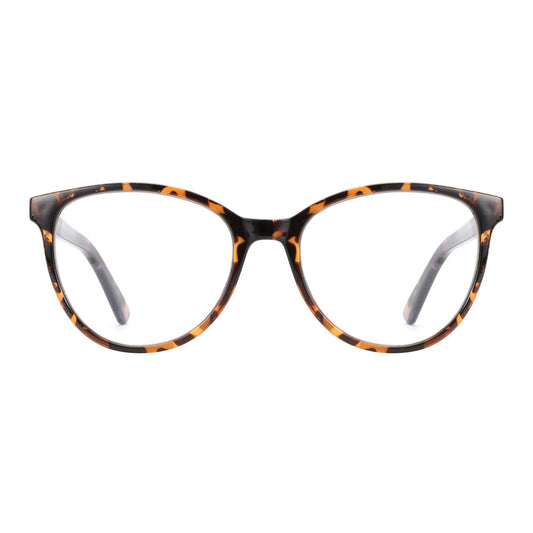
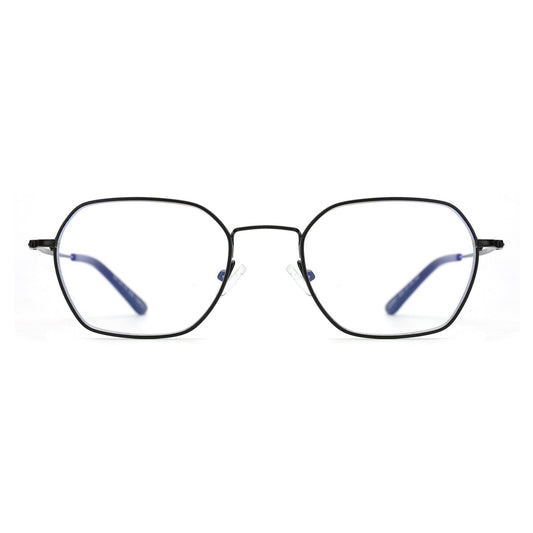
- Thicker Rim Materials: Acetate frames can often hide more of the lens edge than thin metal frames.
Expert Tip: Frame selection is a common variable in high-Rx satisfaction. We recommend eye sizes < 50mm for prescriptions over -6.00D to achieve the best aesthetic result.
Aspheric and Atoric Design: Reducing Distortion
Modern 1.74 lenses are almost exclusively "aspheric." Unlike traditional spherical lenses with a constant curvature, aspheric lenses have a flatter, more complex curvature that changes from the center to the edge. This design helps make the lens thinner and reduces the "fish-bowl" distortion in the periphery.
For users with significant astigmatism, "atoric" designs optimize the lens surface across both principal meridians. This ensures correction is precise regardless of where the wearer looks through the lens. Understanding how to read your eye prescription is the first step in determining if your cylinder (CYL) values—typically those above -2.00—would benefit from atoric surfacing.
Cluster Map: Navigating High-Index Options
| Topic | Focus Area | Reading Path |
|---|---|---|
| Material Comparison | 1.67 vs 1.74 Index | Compare 1.67 and 1.74 |
| Technical Standards | MR™ Resins & ANSI Specs | Technical Standards Guide |
| Prescription Basics | OD, OS, and PD | How to Read Your Rx |
| Measurement Guide | Measuring PD at Home | PD Measurement Guide |
FAQ
Are 1.74 high-index lenses worth the extra cost? For prescriptions above -6.00D or +4.00D, 1.74 lenses generally offer a noticeable improvement in weight and aesthetics. They can reduce the "eye-shrinking" (myopia) or "eye-magnifying" (hyperopia) effect. For lower prescriptions (e.g., -3.00D), the difference between 1.67 and 1.74 may be minimal.
Do 1.74 lenses scratch more easily? 1.74 resins are impact-resistant but inherently softer than CR-39 plastic. Most high-quality 1.74 lenses include a hard scratch-resistant coating. It is advisable to use microfiber cloths and specific lens cleaners, as abrasive materials like paper towels can cause micro-scratches over time.
Can I get 1.74 high-index lenses for rimless glasses? Yes, 1.74 material is suitable for rimless frames due to its tensile strength. The thiourethane resin is generally less prone to "crazing" (stress cracks) around drill holes compared to polycarbonate.
Will 1.74 lenses make my eyes look smaller? High-minus lenses have a natural minifying effect. Because 1.74 lenses are flatter and can sit closer to the eye, they often reduce this effect compared to thicker, more curved lenses, providing a more natural appearance.
Do I need a special prescription for 1.74 lenses? No, a standard prescription is sufficient. However, an accurate Pupillary Distance (PD) is essential. Because high-index lenses have a specific "sweet spot" of optical clarity, precise alignment with your pupils is necessary to avoid eye strain.
How do I clean 1.74 lenses with AR coating? Avoid household glass cleaners containing ammonia. Use a dedicated lens spray and a clean microfiber cloth. Rinsing lenses under lukewarm water before wiping can help remove dust particles that might cause scratches.
References
Government / Standards / Regulators
- ANSI Z80.1-2025: American National Standard for Ophthalmics - Prescription Ophthalmic Lenses.
- ISO 8980-1: Ophthalmic optics — Uncut finished spectacle lenses — Specifications.
- FDA: CFR Title 21, Part 801.410 (Impact resistance requirements).
Industry Associations / Research Institutes
- The Vision Council: Reports on lens material trends and consumer high-index adoption.
- Mitsui Chemicals: Technical data sheets for MR-174™ High-Index Lens Material properties.
Academic / Whitepapers
- Journal of Optometry: Research on adaptation to chromatic aberration in high-index materials.
- Optical Society of America (OSA): Technical papers on aspheric and atoric lens surface optimization.
Platform official docs & policies
- Zenottic Technical Guide: Technical Guide to High-Index Lens Materials and Standards.
