



The Ultimate Guide to High Prescription Eyewear
Summary
Cluster map

Navigating the world of high prescription eyewear requires a shift from purely aesthetic choices to a more technical, precision-oriented approach. For individuals with prescriptions exceeding -6.00 diopters (OD/OS), the primary challenges involve managing lens edge thickness, minimizing total weight, and ensuring optical clarity across the entire lens surface. By selecting high-index materials like 1.67 or 1.74 and pairing them with frames that feature a small "effective diameter" and robust materials like acetate, users can achieve a sleek, professional look that eliminates the "coke bottle" effect. This guide provides the technical framework necessary to make informed decisions, balancing refractive index benefits against optical trade-offs like chromatic aberration to ensure your vision is as sharp as your style.
Key takeaways
- Prioritize High-Index Materials: For prescriptions above -6.00D, 1.67 or 1.74 high-index lenses are essential for reducing edge thickness by up to 35% compared to standard plastic.
- Optimize Frame Geometry: Look for frames with a small lens diameter and a low "effective diameter" (the longest diagonal measurement) to naturally minimize the thickest parts of the lens.
- Precision in Measurement: Accurate Pupillary Distance (PD) and monocular measurements are critical to avoid prismatic effects that cause eye strain and headaches in strong prescriptions.
- Material Matters: Thick acetate frames are superior for high prescriptions as they physically hide lens edges and provide the necessary structural support for heavier lenses.
- Understand Optical Trade-offs: Higher index lenses often have lower Abbe values, meaning you must balance the desire for thinness with the need for high-contrast, distortion-free vision.
Decoding the High Prescription: When Does it Matter?
In the clinical world, "high myopia" is typically defined as a refractive error of -6.00 diopters or greater. However, from a practical eyewear perspective, the "high prescription" threshold often begins around -4.00D. This is the point where standard 1.50 index plastic lenses begin to show significant edge thickness, and the weight of the glasses can start to cause discomfort on the bridge of the nose. Understanding your prescription is the first step toward better eyewear; you can learn to read your glasses prescription to identify the specific sphere (SPH) and cylinder (CYL) values that dictate your lens needs.
For those with strong prescriptions, the lens isn't just a piece of plastic; it's a complex optical tool. As the power increases, the curvature of the lens must become steeper. In a "minus" lens (for nearsightedness), this results in a thin center and thick edges. The goal of high-index technology is to bend light more efficiently, allowing for a flatter lens curve and, consequently, a thinner profile.
Logic Summary: The -6.00D threshold is a clinical standard for increased ocular health risks, but the -4.00D practical threshold is where material science becomes the primary driver of user satisfaction. We recommend high-index transitions starting at -4.00D to maintain aesthetic and ergonomic standards.
The Science of Thinness: High-Index Lens Materials
The refractive index of a lens material measures how effectively it bends light. Standard plastic has an index of 1.50, while high-index materials range from 1.61 to 1.74. As the index increases, the lens can be made thinner and lighter for the same prescription power.
1.67 vs. 1.74: The Battle of the Indices
When you reach the -8.00D range, the choice between 1.67 and 1.74 becomes a major decision point. You can compare 1.67 vs 1.74 high-index lenses to see the specific thickness differences. Generally, 1.74 lenses are about 10-15% thinner than 1.67 lenses. While this sounds significant, it’s important to note the law of diminishing returns. For a -6.00D prescription, the visual difference in thickness between 1.67 and 1.74 might only be a fraction of a millimeter, while the cost can increase by 50% or more.

The Abbe Value Trade-off
A critical but often overlooked factor is the Abbe value, which measures the material's "chromatic aberration"—the tendency of a lens to break light into its component colors. Standard plastic has a high Abbe value (around 58), meaning very little color fringing. High-index 1.74 lenses typically have an Abbe value around 32. This means that while the lens is thinner, you might notice slight rainbows or blurring at the edges of your vision. If you are sensitive to visual distortions, you might find that 1.67 (Abbe value ~32-36) or even 1.61 offers a better balance of clarity and thinness.
Shop 1.74 high-index lenses if your priority is the absolute thinnest profile possible, especially for prescriptions exceeding -10.00D.
Frame Selection: Hiding Edge Thickness and Minimizing Weight
Choosing the right frame is perhaps more important than choosing the lens material. A common mistake is selecting a large, trendy frame that forces the lab to use the thickest part of the lens blank.
The "Effective Diameter" Rule
Most people look at the "lens width" (e.g., 52mm) when buying frames. However, for high prescriptions, the "Effective Diameter" (ED) is the metric that matters. ED is the longest diagonal measurement across the lens. A square frame with a 50mm width might have a much larger ED than a round frame with the same width. Since lens thickness increases exponentially as you move away from the optical center, a larger ED guarantees thicker edges.
Why Acetate is the Gold Standard
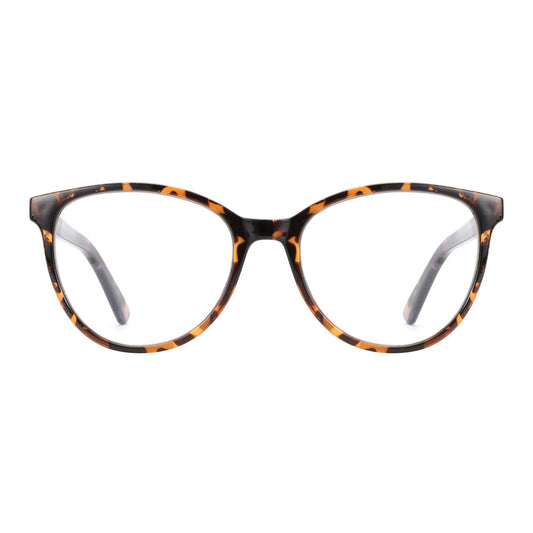
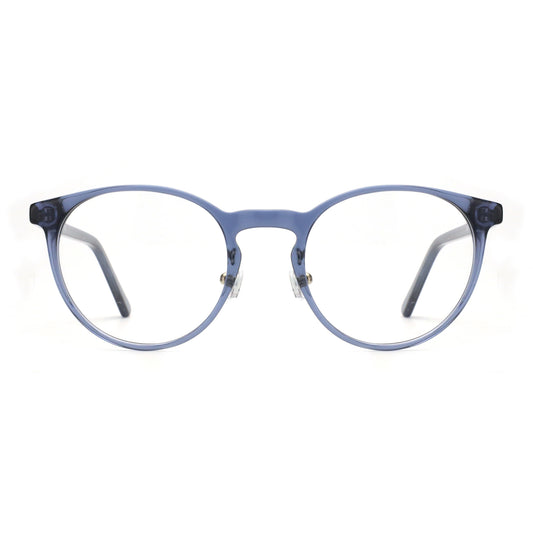
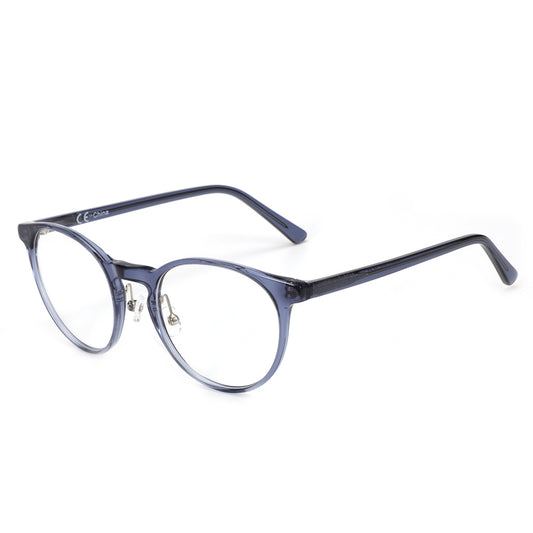
For high-prescription users, browse stylish acetate frames rather than thin metal ones. Acetate frames are naturally thicker, which allows them to "hide" the edge of a high-index lens within the frame rim. Furthermore, acetate provides a more stable platform for heavier lenses, preventing the frames from becoming front-heavy and sliding down your nose.
Logic Summary: Frame selection is a geometric optimization problem. By minimizing the distance from the optical center to the furthest edge of the frame (ED), we minimize the volume of material required. Acetate is recommended for its ability to mask edge thickness and its superior weight distribution.
The Critical Role of Precision: PD and Optical Alignment
With a strong prescription, there is zero room for error in measurement. The most vital measurement is your Pupillary Distance (PD). If the optical center of the lens is not perfectly aligned with your pupil, it creates a "prismatic effect."
Prentice's Rule and Prismatic Distortion
According to Prentice's Rule (Prism = Decentration in cm × Power in Diopters), the higher the prescription, the more prism is created by even a tiny misalignment. For example, if a -8.00D lens is off by just 2mm (0.2cm), it creates 1.6 prism diopters of distortion. This can lead to double vision, severe headaches, and a feeling of "pulling" in the eyes. To ensure your glasses are comfortable, you must get the perfect glasses fit through precise measurement.
For prescriptions above -8.00D, we recommend using monocular PD (a separate measurement for each eye) rather than a single binocular PD, as most human faces are slightly asymmetrical.
Advanced Optics: Vertex Distance and Effective Power
Vertex distance is the space between the back of your glasses lens and the front of your cornea. For low prescriptions, this distance doesn't change the perceived power much. However, for high prescriptions, it is significant.
If your glasses sit further away from your eyes than they did during your eye exam, a "minus" lens will feel weaker. Conversely, if they sit closer, they will feel stronger. This is why some people feel "dizzy" with new high-prescription glasses even if the prescription is correct—the frame fit has changed the effective power. When you find glasses for your face shape, ensure the bridge fit keeps the lenses at a consistent distance from your eyes.
Comparing High-Prescription Lens Materials
| Material | Refractive Index | Abbe Value | Thickness Reduction* | Ideal Prescription Range |
|---|---|---|---|---|
| Standard Plastic | 1.50 | 58 | 0% (Baseline) | Plano to -2.00 |
| Polycarbonate | 1.59 | 30 | ~20% | -2.00 to -4.00 |
| 1.61 High-Index | 1.61 | 36-41 | ~25% | -3.00 to -5.00 |
| 1.67 High-Index | 1.67 | 32 | ~30% | -5.00 to -8.00 |
| 1.74 High-Index | 1.74 | 32 | ~35% | -8.00 and above |
*Thickness reduction is an estimate based on a standard 50mm lens diameter; actual results vary by frame size and PD.
FAQ
What is considered a high prescription for glasses? In clinical terms, a high prescription (high myopia) is generally defined as -6.00 diopters or higher. However, for the purposes of selecting eyewear, anything above -4.00 diopters is considered high because this is the threshold where standard lenses become noticeably thick and heavy. At this level, high-index materials and specific frame shapes become necessary to maintain comfort and aesthetics.
Which frame shape is best for hiding thick lenses? Round or oval frames are generally the best for high prescriptions because they have the smallest "effective diameter." Because minus lenses are thinnest in the center and thickest at the edges, a round shape removes the corners where the lens would be at its thickest. Avoid large, rectangular, or aviator-style frames, as these have wide corners that will showcase the maximum thickness of the lens.
Are 1.74 high-index lenses worth the extra cost? 1.74 lenses are the thinnest and lightest plastic lenses available, making them "worth it" for individuals with prescriptions over -8.00D who are concerned about edge thickness. However, for prescriptions between -4.00D and -7.00D, the difference between 1.67 and 1.74 is often negligible (less than 1mm). In these cases, 1.67 often provides a better value while still offering a very thin profile.
Why do my high-prescription glasses make my eyes look small? This is a natural optical effect called "minification," which occurs with all minus lenses used to treat nearsightedness. High-index lenses help reduce this effect slightly because they are flatter, but they cannot eliminate it entirely. To minimize minification, choose frames that sit as close to your eyes as comfortably possible (reducing vertex distance) and avoid oversized lenses.
Can I get rimless glasses with a high prescription? While technically possible with high-index materials, rimless glasses are generally not recommended for prescriptions above -6.00D. The edges of the lenses will be fully exposed, making the thickness very obvious. Additionally, the weight of the lenses can put undue stress on the drill points, leading to more frequent breakages. A full-rim acetate frame is a much more durable and aesthetically pleasing choice.
What is the Abbe value, and why does it matter for my lenses? The Abbe value is a measure of how much a lens material disperses light. A higher Abbe value means less chromatic aberration (color fringing) and clearer vision. High-index lenses typically have lower Abbe values than standard plastic, which can cause some users to see "rainbows" around lights or at the edges of their vision. Balancing thinness (high index) with clarity (high Abbe value) is key to finding the right lens for your needs.
References
Industry Associations & Standards
- The Vision Council: Research and Reports on Lens Technology
- American Optometric Association (AOA): Clinical Practice Guidelines for Myopia
Technical & Academic Resources
- Optical Journal: Understanding Prentice's Rule and Prismatic Effects
- ScienceDirect: Refractive Index and Abbe Value in Optical Materials
Platform & Manufacturer Documentation
- Zeiss Vision Science: High-Index Lens Design Principles
- EssilorLuxottica: Lens Material Comparison Guides
Community & Intent Discovery
- Reddit r/Glasses: User experiences with 1.74 high-index lenses (Intent only; not authoritative)
