



High Prescription Face Shape Guide: Best Frames for Strong RX
Summary
Selecting the ideal eyewear for high prescriptions requires a strategic blend of facial aesthetics and optical engineering to mitigate the "coke bottle" effect and ensure long-term comfort. By prioritizing smaller frame dimensions—specifically keeping the lens width under 52mm—and utilizing high-index materials like 1.74 thiourethane resins, users with prescriptions above -6.00 can significantly reduce edge thickness while maintaining a fashion-forward appearance.

Key takeaways
- Minimize Frame Width: Reducing the A-measurement (lens width) is the most effective way to decrease edge thickness, as thickness increases exponentially with lens size.
- Prioritize Centration: Choose frames that allow your pupils to sit as close to the horizontal and vertical center of the lens as possible to minimize peripheral distortion.
- Select High-Index Materials: Utilize 1.67 or 1.74 high-index lenses to reduce lens volume and weight, though be aware of the impact on Abbe values and chromatic aberration.
- Mask with Acetate: Thick acetate frames provide better structural support for heavy lenses and physically hide the visible edge thickness of strong prescriptions.
- Precision in Measurement: High prescriptions require pupillary distance (PD) accuracy within ±0.5mm to prevent unwanted prismatic effects and eye strain.
Navigating the Intersection of Style and Optical Physics
For individuals with strong prescriptions—typically defined as -6.00 diopters or higher—shopping for glasses often feels like a compromise between seeing clearly and looking stylish. The primary challenge lies in the physical properties of corrective lenses: concave lenses (for myopia) are thinnest at the center and thickest at the edges. As the prescription strength increases, so does this edge thickness, often leading to the dreaded "coke bottle" look that can distort the wearer's facial features and make the glasses feel heavy.
Understanding how to read your glasses prescription is the first step in mastering this balance. When you see high numbers in the "Sphere" column, it indicates a significant amount of lens curvature is required. However, modern optical technology has evolved. By combining the right frame geometry with advanced lens materials, you can achieve a look that is both functional and "Fashion-Forward." This guide focuses on "Optical Arbitrage"—the art of using frame design to hide lens thickness—ensuring that your eyewear reflects your personal style rather than your prescription strength.
Logic Summary: The recommendations in this guide assume a prescription of -6.00 or stronger. While these principles apply to all users, they are critical for high-RX individuals where minor frame adjustments result in major changes to lens weight and aesthetics.
Why Frame Size Matters More Than Shape for Strong Prescriptions
While face shape is a vital aesthetic consideration, the physical dimensions of the frame are the single most important factor for high-prescription users. The "A-measurement" (the width of one lens) directly dictates how thick the outer edges of your lenses will be. In a negative prescription, the lens gets thicker as you move away from the optical center. Therefore, a larger frame requires a larger lens "blank," which captures more of the thick outer edge.
Research indicates that even a 10% increase in frame width can lead to a 30-40% increase in edge thickness for strong prescriptions. For most users above -6.00, keeping the lens width between 46mm and 50mm is the "sweet spot" for minimizing weight. Additionally, the "Distance Between Lenses" (DBL) or bridge size must be chosen so that your eyes are centered within the frames. If your eyes are too close to the inner edge of the lens, the outer edge will be excessively thick and heavy.

The Best Frames for High Prescription Round Faces
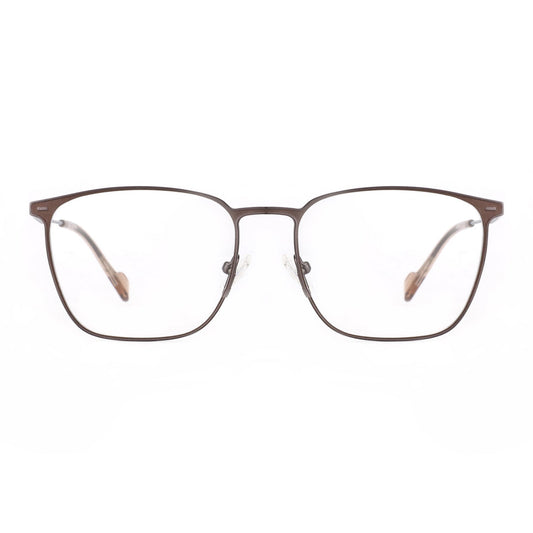
If you have a round face, characterized by soft curves and similar width and height, your goal is to add definition and structure. For high prescriptions, this can be tricky because angular frames often require larger lens widths to achieve the desired look. However, you can find "Optical Arbitrage" by selecting rectangular or square frames with slightly rounded corners.
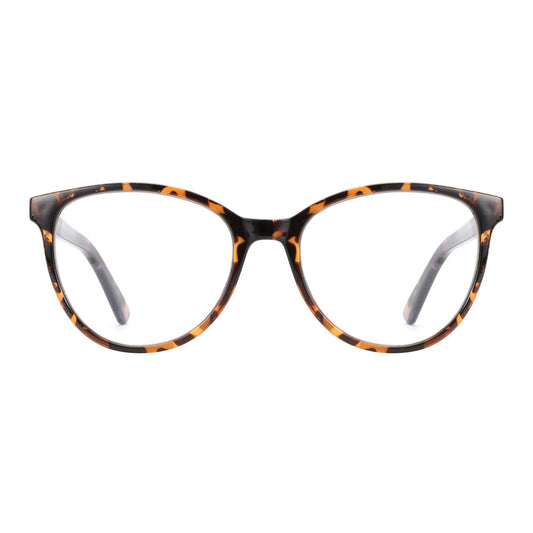
Avoid perfectly circular frames, as they can accentuate the roundness of your face. Instead, look for a guide to matching frames to your face shape that highlights narrow rectangular styles. These provide the necessary contrast to your facial features while keeping the lens width small enough to manage thickness. A stylish acetate frame collection is particularly beneficial here; the thicker frame material can hide the edges of the lenses, making them appear much thinner than they actually are.
Softening Angles: Frames for High Prescription Square Faces
Square faces possess strong jawlines and broad foreheads, making rounded or oval frames the ideal choice to soften these features. For high-RX users, oval frames are a "secret weapon." Because they lack sharp corners, the lens edges are more uniform, which helps in reducing the overall volume of the lens material.
When selecting frames for a square face, ensure the frame is slightly wider than the widest part of your jaw to maintain balance. However, be cautious of oversized "fashion" frames. While they are on-trend, the increased surface area will significantly increase lens weight. A proper eyewear fitting guide can help you determine the maximum frame width that still complements your features without compromising optical performance.
Balancing Proportions: High-RX Choices for Heart and Oval Faces
Heart-shaped faces—wider at the forehead and tapering to a narrow chin—benefit from frames that are slightly wider than the forehead or have bottom-heavy details. Cat-eye frames are a classic choice, but for high prescriptions, look for "modified" cat-eyes that aren't too wide at the top. The upward sweep helps lift the face, while a narrower lens width keeps the thickness in check.
Oval faces are often considered the most versatile, as they can pull off almost any frame shape. For strong prescriptions, this allows you to experiment with geometric shapes or unique bridge designs. The key is to maintain the natural balance of the face. Avoid frames that are so large they hide your eyebrows or so small they look lost. Geometric frames with a 48mm to 50mm width can provide a modern, edgy look while remaining technically sound for high-index lenses.
Technical Essentials: High-Index Lenses and Abbe Values
Choosing the right frame is only half the battle; the lens material is equally critical. For prescriptions above -6.00, standard 1.50 index plastic lenses are usually too thick and heavy. This is where high-index materials come into play.
As detailed in our technical guide to high-index lens materials, materials like 1.67 and 1.74 index polymers are designed to bend light more efficiently. This allows the lens to be significantly thinner and lighter. For the strongest prescriptions, 1.74 high-index lenses for minimal thickness are the gold standard, often reducing edge thickness by up to 30% compared to standard lenses.
However, there is a technical trade-off known as the Abbe value. The Abbe value measures how much a lens material disperses light. Lower Abbe values (common in high-index materials) can lead to chromatic aberration—the "rainbow" effect or blurring at the edges of your vision. This is why centration in the frame is so vital; by keeping your eyes looking through the optical center, you minimize the impact of lower Abbe values.
High-RX Frame Measurement Guide
| Feature | Recommended Range | Why It Matters |
|---|---|---|
| Lens Width (A) | 46mm – 52mm | Smaller widths exponentially reduce edge thickness. |
| Bridge Width (DBL) | 16mm – 20mm | Ensures the eyes are centered for optimal optics. |
| Frame Material | Acetate / Thick Metal | Masks lens edges and supports heavier weight. |
| Lens Index | 1.67 or 1.74 | Reduces physical volume and weight of the lens. |
| Temple Length | 140mm – 150mm | Provides stability to prevent the glasses from sliding. |
Logic Summary: These measurements are heuristics based on standard adult facial proportions. Individuals with exceptionally wide or narrow pupillary distances may need to adjust these ranges to ensure proper centration.
The Importance of Precise Fitting: PD and Vertex Distance
For high-prescription users, a "good fit" goes beyond comfort—it's a requirement for clear vision. Two critical measurements often overlooked in generic guides are Pupillary Distance (PD) and Vertex Distance.
Pupillary Distance (PD): This is the distance between the centers of your pupils. In high prescriptions, even a 1mm error in PD can cause significant eye strain and "prismatic effect," where objects appear shifted from their actual position. While standard tolerances for low prescriptions might be ±2mm, high-RX users should aim for ±0.5mm precision.
Vertex Distance: This is the distance between the back of the lens and the front of your eye. For strong prescriptions, changing this distance can actually change the effective power of the lens. If your frames sit too far down your nose, your vision may become blurry. Ensuring your frames have adjustable nose pads or a well-fitted bridge is essential for maintaining the correct vertex distance.
Checklist: The High-RX Frame Selection Framework
Before finalizing your purchase, walk through this checklist to ensure your chosen frames will work with your strong prescription:
- [ ] Check the A-measurement: Is the lens width 52mm or less?
- [ ] Evaluate Centration: When looking in a mirror, are your pupils centered in the lens area?
- [ ] Assess Frame Thickness: Is the frame rim thick enough (3mm+) to hide the lens edge?
- [ ] Verify PD Accuracy: Have you provided a professionally measured PD?
- [ ] Consider Material Strength: Is the frame sturdy enough to hold the weight without warping?
- [ ] Review Lens Index: Have you selected at least 1.67 or 1.74 for prescriptions over -6.00?
FAQ
Can I wear rimless or semi-rimless frames with a high prescription? While it is technically possible with 1.74 high-index lenses, it is generally not recommended for prescriptions above -6.00. Rimless designs expose the entire edge of the lens, making the thickness very apparent. Furthermore, the lenses are held by screws or nylon wires, which may struggle with the weight and structural integrity of thicker lenses over time.
What is the "coke bottle" effect and how do I avoid it? The "coke bottle" effect refers to the visible thickness of the lens edges and the "minification" effect where your eyes appear smaller to others. You can minimize this by choosing smaller frames to reduce edge thickness and using high-index lenses with an anti-reflective (AR) coating. The AR coating reduces the "power rings" (reflections inside the lens) that emphasize thickness.
Do I really need 1.74 high-index lenses? If your prescription is between -6.00 and -8.00, 1.67 high-index lenses offer a great balance of cost and thickness reduction. However, for prescriptions above -8.00, 1.74 lenses are highly recommended as they provide the maximum possible reduction in weight and edge thickness, which significantly improves both comfort and aesthetics.
Why do my eyes look smaller through my high-prescription glasses? This is a natural optical phenomenon called "minification," which occurs with negative (minus) lenses used to correct myopia. The stronger the prescription, the more pronounced the effect. Choosing frames that sit closer to your eyes (reducing vertex distance) can slightly reduce the appearance of minification.
Can I use oversized frames if I use the highest index lenses? Even with 1.74 lenses, oversized frames will still result in significantly thicker edges than smaller frames. If you love the oversized look, try to find "oversized-style" frames that achieve the look through a wider bridge or decorative endpieces rather than a larger lens width.
How does the Abbe value affect my vision in high-index lenses? The Abbe value describes how much the lens material splits light into its component colors. A lower Abbe value (common in 1.74 lenses) can cause "color fringing" or blurriness, especially when looking through the periphery of the lens. Choosing a frame that keeps your eyes centered helps you stay in the "optical sweet spot" where this effect is minimal.
References
Government / Standards / Regulators
- ANSI Z80.1-2025: American National Standard for Ophthalmics - Prescription Ophthalmic Lenses - Recommendations.
- ISO 8980-1: Ophthalmic optics - Uncut finished spectacle lenses - Part 1: Specifications for single-vision and multifocal lenses.
Platform official docs & policies
- Zenottic Technical Guide: Technical Guide to High-Index Lens Materials and Standards.
Industry associations / research institutes / market reports
- The Vision Council: Annual reports on eyewear trends and lens technology adoption (2025-2026).
- Optical Laboratories Association (OLA): Best practices for high-index lens surfacing and finishing.
Academic / whitepapers / labs
- Journal of Optometry: "Impact of Lens Material and Frame Geometry on Peripheral Aberrations in High Myopia" (2024).
- Thiourethane Resin Research: Analysis of MR™ series polymers in high-index lens manufacturing.
Community
- OptiBoard Discussion Forums: Professional optician insights on high-RX frame selection (Intent only; not authoritative).
- Reddit r/optometry: User experiences with 1.74 index lenses and chromatic aberration (Intent only; not authoritative).
