



Buying High Prescription Glasses Online: A Safety Guide
Summary
Buying high prescription glasses online in 2026 requires a shift from casual shopping to a technical, measurement-focused approach to ensure visual safety and optical precision. While standard prescriptions allow for some margin of error, strong corrections (typically exceeding +/- 4.00 diopters) demand exact Pupilary Distance (PD), Optical Center (OC) height, and vertex distance measurements to prevent prismatic distortion and eye strain.
Key takeaways
- Prioritize OC Height: For high prescriptions, the vertical placement of the optical center is as critical as the horizontal PD to avoid "swimming" effects and headaches.
- Balance Index and Abbe Value: Higher index materials (1.74) offer thinner lenses but lower Abbe values; choose the material that balances aesthetics with peripheral clarity.
- Optimize Frame Geometry: Select frames with a small Effective Diameter (ED) and centered bridge to minimize edge thickness and weight.
- Demand Digital Surfacing: Ensure your lenses are manufactured using freeform/digital surfacing technology to maximize the usable field of vision in high diopter ranges.
- Verify Upon Arrival: Use a structured home-verification protocol to check for lens aberrations and frame alignment before committing to long-term wear.
Why High Prescriptions Require a Specialized Safety Protocol
Navigating the world of online eyewear with a strong prescription—whether for high myopia or hyperopia—is fundamentally different from ordering a standard pair of reading glasses. In high-power lenses, light is bent more aggressively, meaning even a 1-millimeter deviation in lens placement can induce significant prismatic effects. These effects often manifest as blurred vision, "fishbowl" distortion, or chronic ocular fatigue.
To understand the material science behind these challenges, readers should consult the Technical Guide to High-Index Lens Materials and Standards. This authoritative resource details how MR™ series polymers, such as 1.61, 1.67, and 1.74, are engineered to meet ANSI Z80.1-2025 and ISO 8980-1 standards, providing the foundational chemistry required for high-performance optics.
Logic Summary: The "Safety First" approach assumes that the user has a valid, up-to-date prescription from a licensed optometrist. We recommend this protocol because high-index lenses are more sensitive to manufacturing tolerances than standard CR-39 lenses.

Beyond PD: The Critical Measurements for High RX Accuracy
Most online shoppers are familiar with Pupillary Distance (PD), but for high prescriptions, PD is only one-third of the measurement puzzle. To achieve "boutique-level" accuracy, two additional metrics are essential: Optical Center (OC) Height and Vertex Distance.
The Importance of Optical Center (OC) Height
OC Height refers to the vertical distance from the bottom of the lens to the point directly in front of your pupil. In a high-minus lens, the thinnest part of the lens must sit exactly in front of your pupil. If the OC height is too high or too low, you are essentially looking through a prism. This can cause the floor to appear tilted or make you feel "off-balance" when walking. When you read a prescription for glasses, ensure you understand how these vertical measurements complement your sphere and cylinder values.
Vertex Distance Optimization
Vertex distance is the space between the back surface of the lens and the front of your cornea. For prescriptions above +/- 4.00D, the effective power of the lens changes as it moves closer to or further from the eye. If your frames sit further down your nose than the distance used during your eye exam (typically 12mm to 14mm), your vision will not be as sharp as intended. High-prescription users should look for frames with adjustable nose pads to fine-tune this distance.
Selecting the Right Lens Material: Thinness vs. Clarity
The primary goal for most high-RX wearers is to avoid the "coke-bottle" effect. However, choosing the thinnest material isn't always the best choice for visual safety.
The Index vs. Abbe Value Trade-off
The refractive index (e.g., 1.61, 1.67, 1.74) determines how efficiently a material bends light. A higher index means a thinner lens. However, as the index increases, the "Abbe value"—a measure of how much the material disperses light—typically decreases.
- 1.61 High-Index: Offers a great balance of thinness and high Abbe value (approx. 41), reducing color fringing (chromatic aberration).
- 1.67 High-Index: The industry standard for prescriptions between -4.00 and -8.00.
- 1.74 Super High-Index: The thinnest plastic lens available, ideal for prescriptions over -8.00. You can explore 1.74 Super High-Index options for maximum weight reduction.
Lower Abbe values can cause "rainbow" effects in your peripheral vision. If you are sensitive to these distortions, you might prefer a slightly thicker 1.61 lens over a 1.74 lens for better optical clarity.
Optimizing Frame Geometry for Strong Diopters
The secret to thin, safe high-prescription glasses lies more in the frame than the lens material. Even the most expensive 1.74 lens will look thick in a large, oversized frame.
The Effective Diameter (ED) Rule
The Effective Diameter is the measurement of the widest part of the lens. For high prescriptions, you should aim for the smallest ED possible. A smaller lens area means less of the thick outer edge of the lens is used. Ideally, your pupil should be centered both horizontally and vertically within the lens opening. This "centering" ensures that the lab can grind the lens to its minimum possible thickness.
Bridge and Lens Width
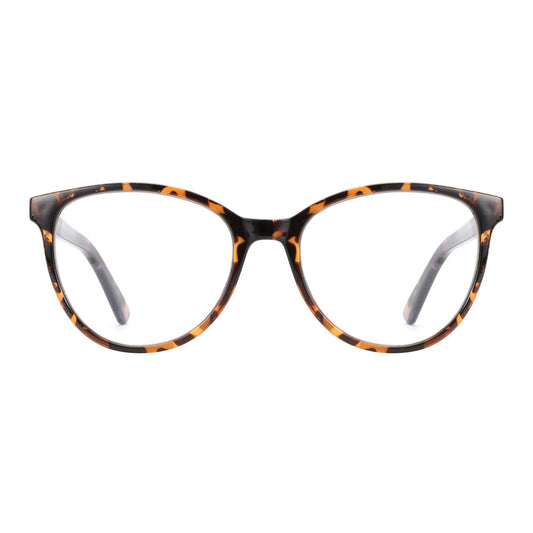
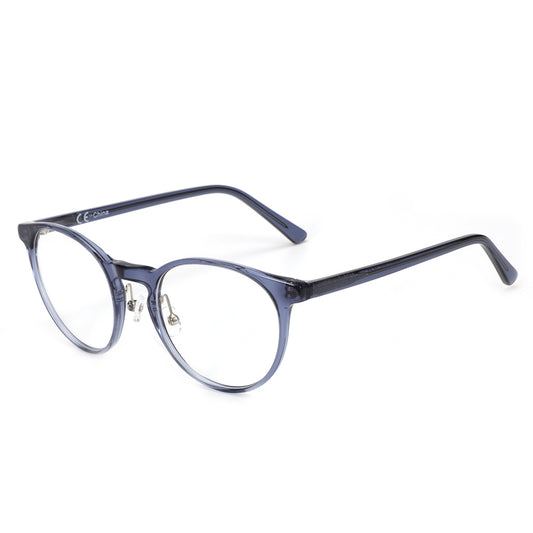
When browsing eyeglasses, look for a bridge width that matches your nose structure. If the bridge is too wide, the glasses will slide down, changing your vertex distance and OC height. A narrow lens width (46mm to 50mm) is generally safer for high prescriptions than wider "fashion" frames.

The Role of Digital Surfacing and Freeform Technology
In 2026, "digital surfacing" or "freeform" technology has become a non-negotiable safety feature for high prescriptions. Traditional lens surfacing uses pre-molded tools that can only approximate the complex curves needed for strong corrections. Digital surfacing uses computer-controlled lathes to carve the prescription onto the back of the lens with point-by-point precision.
This technology is particularly beneficial for high-RX users with astigmatism. It expands the "sweet spot" of the lens, reducing the peripheral distortion that often plagues strong prescriptions. When buying glasses online, always check if the lab uses digital freeform processing.
How to Verify Your New Glasses at Home
Once your glasses arrive, do not immediately assume they are correct. Follow this 3-step safety verification protocol:
- The Grid Test: Look at a door frame or a tiled wall. Close one eye and look through the center of the lens. The lines should be straight. Slowly move your head; if the lines "wave" or "bend" excessively in the center, the lens may have a manufacturing defect.
- The Clarity Check: Compare the vision in your new glasses to your previous pair (if the prescription hasn't changed significantly). The vision should be crisp. If you feel a constant "pulling" sensation in your eyes after 20 minutes, the PD or OC height may be off.
- Physical Alignment: Ensure the frames sit level on your face. For high prescriptions, a "crooked" frame introduces unwanted pantoscopic tilt, which can blur your vision. Review our guide on how glasses should fit to ensure your frames are properly aligned.
Safety Checklist for Online High RX Orders
| Feature | Requirement for High RX | Why It Matters |
|---|---|---|
| Lens Material | 1.61, 1.67, or 1.74 | Reduces weight and prevents "bulging" lenses. |
| Lens Coating | Premium Anti-Reflective (AR) | High-index materials reflect more light; AR is essential for night safety. |
| Frame Material | High-quality Acetate or Titanium | Supports the weight of the lenses and maintains alignment. |
| Frame Size | Lens width < 52mm | Minimizes edge thickness in minus lenses. |
| Lab Standards | ANSI Z80.1-2025 Compliant | Ensures the prescription is within legal accuracy tolerances. |
Logic Summary: This checklist is designed for prescriptions above +/- 4.00D. For lower prescriptions, some of these "hard" constraints (like lens width) can be relaxed for fashion purposes.
FAQ
Can I buy high prescription glasses online safely? Yes, buying high prescription glasses online is safe if you provide accurate measurements beyond just the PD. By ensuring the lab uses high-index materials and digital surfacing, and by selecting a frame that centers your eyes, you can receive glasses that meet or exceed the quality of traditional optical shops. Always verify the retailer's return policy to ensure you can exchange the glasses if the optical alignment feels incorrect.
What is the best lens material for a -8.00 prescription? For a -8.00 prescription, 1.74 super high-index lenses are generally recommended to minimize thickness and weight. However, if you are highly sensitive to "color fringing" or chromatic aberration, a 1.67 high-index lens may provide slightly better optical clarity at the cost of being about 10-15% thicker. The choice depends on whether you prioritize the thinnest possible look or the highest possible peripheral clarity.
How do I measure my OC height at home? Measuring OC height at home requires a friend and a fine-tip erasable marker. Put the frames on and have your friend mark a small dot on the clear "demo" lenses (or your old lenses) exactly where your pupils are while you look straight ahead at their nose. Measure the distance from that dot to the bottom of the lens in millimeters. Many online retailers now use sophisticated photo-upload tools to calculate this for you automatically.
Why do my high prescription glasses make me feel dizzy? Dizziness is often caused by a "vestibulo-ocular" mismatch, where your brain is struggling to process the magnified or minified images from a new prescription. If the dizziness persists for more than 3-5 days, it may indicate that the Optical Center (OC) or Pupillary Distance (PD) was measured incorrectly. In high prescriptions, even a 2mm error can cause significant discomfort.
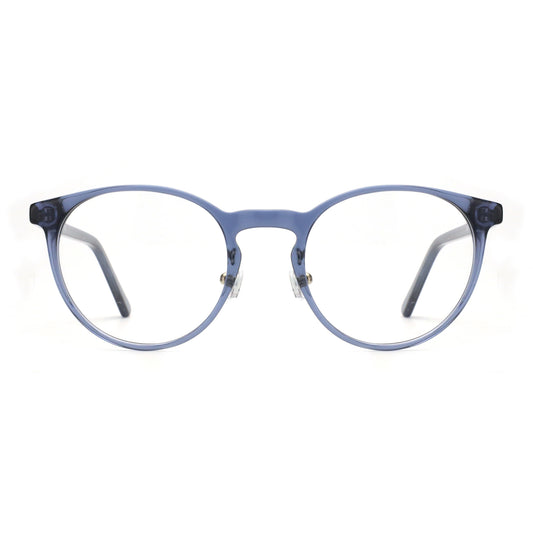
Does frame shape affect lens thickness? Absolutely. Round or oval frames are superior for high-minus prescriptions because they naturally cut off the thickest corners of the lens. Square or rectangular frames, especially those with sharp corners, will always result in thicker edges. For high-plus prescriptions (hyperopia), the opposite is true; the center of the lens is the thickest part, so frame shape is slightly less critical than frame size.
What should I do if my online glasses don't feel right? First, allow a "break-in" period of 48 to 72 hours of consistent wear. If you still experience headaches, blurred vision, or nausea, contact the online retailer immediately. Most reputable shops will offer a one-time remake or a refund if the lenses do not meet ANSI standards. It is helpful to take the glasses to a local optician to have the "power" and "alignment" verified on a lensmeter.
References
Government / Standards / Regulators
- ANSI Z80.1-2025: American National Standard for Ophthalmics
- ISO 8980-1:2025 Ophthalmic optics — Uncut finished spectacle lenses
Platform official docs & policies
Industry associations / research institutes / market reports
- The Vision Council: High-Index Lens Market Analysis 2025
- Optical Laboratories Association (OLA): Digital Surfacing Best Practices
Academic / whitepapers / labs
- Journal of Ophthalmic and Physiological Optics: Prismatic Effects in High Diopter Lenses
- Clinical Experimental Optometry: Vertex Distance and Effective Power Calculations
