



The High-Prescription Optimization Guide: Engineering Thinner Lenses
The Engineering Behind "Coke Bottle" Lenses
For those with prescriptions of -6.00 diopters or stronger, achieving a "thin" look is an engineering challenge. While many consumers believe a high-index material is a magic fix, the final edge thickness is actually the result of an interaction between lens power, frame geometry, and how the glasses sit on your face.

In minus prescriptions (for nearsightedness), lenses are thinnest at the center and thickest at the edges. As the prescription strength increases, the "slope" of the lens becomes steeper. The Vision Council’s dispensing guide notes that while high-index materials (1.67 or 1.74) help by bending light more efficiently, they cannot overcome poor frame choice or improper centering.
Frame Selection: The #1 Factor for Thinness
The most effective way to reduce the "coke bottle effect" isn't the lens material—it's the frame size. Specifically, you want to minimize the distance between your pupil and the edge of the lens.
- Small Lens Openings: A smaller "eye size" (the first number in frame dimensions, e.g., 48mm vs 54mm) significantly reduces edge thickness because the thickest part of the lens is simply cut away during the glazing process.
- The "Boxed Center Distance" (BCD) Rule: Ideally, the center of the frame's lens opening should align closely with your pupil. Resources on maximizing lens appearance suggest that the closer your Pupillary Distance (PD) is to the frame's geometric center, the less "decentration" is required.
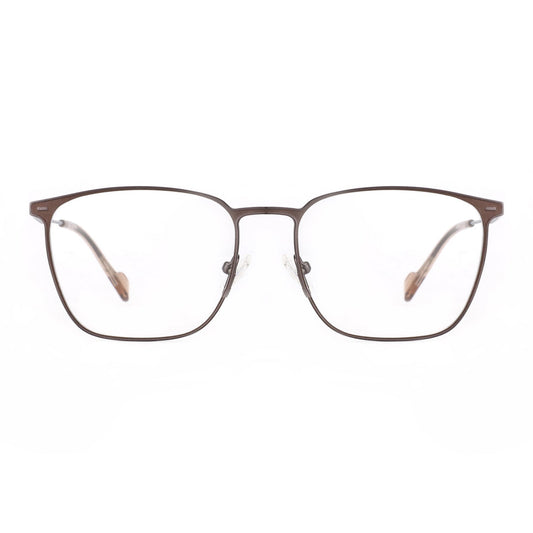
Expert Tip: Avoid oversized, "aviator," or wide rectangular frames. These shapes force the lab to use the thickest part of the lens blank to cover the corners, resulting in heavy, unsightly edges even with 1.74 index lenses.
Minimizing Decentration: Why PD Alignment Matters
Decentration occurs when your pupil does not sit in the exact center of the lens opening. To ensure you can see clearly, the lab must shift the "optical center" of the lens to match your pupil.
According to ISO 13666 standards, this shift increases the thickness of the lens on the side furthest from the shift. If you have a narrow PD but choose a wide frame, the "outer" edges of your lenses will be significantly thicker.
Heuristic for High Prescriptions: Aim for a frame where your eyes sit as close to the horizontal center of each lens as possible. A decentration of less than 2–3mm per eye is a common target for optimal cosmetic results.

Advanced Lens Designs: Aspheric and Digital Surfacing
Standard "spherical" lenses have a constant curve, which can lead to a "bulging" look and peripheral distortion.
- Aspheric Lenses: These use a flatter, more complex curve that reduces the "magnification" (or minification) effect, making your eyes look more natural and the lens edges slightly thinner.
- Double Aspheric: These apply this flattening to both the front and back surfaces. While they offer marginal gains in thinness, their primary benefit is often a wider field of clear vision.
- Digital Surfacing (Freeform): This is a manufacturing process where a computer-guided diamond tool carves the prescription onto the lens with point-by-point precision. Optical design research indicates that while digital surfacing improves clarity, its impact on physical thickness is secondary to frame choice and index.
Choosing the Right Index: 1.67 vs. 1.74
The "index" refers to how efficiently the material bends light.
- 1.60 Index: Great for moderate prescriptions up to -4.00 or -5.00.
- 1.67 Index: The "sweet spot" for prescriptions between -6.00 and -8.00. It offers a significant reduction in thickness with good optical clarity.
- 1.74 Index: The thinnest plastic material available. It is most beneficial for prescriptions over -8.00 or for those who insist on slightly larger frames.
Note that higher-index materials often have a lower "Abbe Value," which can lead to "color fringing" (chromatic aberration) in the periphery. For a deeper dive, see our 1.67 vs 1.74 High-Index Lenses comparison.
Vertex Distance: The "Hidden" Variable
Vertex distance is the space between the back of the lens and your eye.
- The Optical Effect: If a lens sits closer to your eye (shorter vertex distance), it may require slightly less "minus" power to achieve the same correction.
- The Cosmetic Effect: Lenses that sit closer to the face reduce the "face-form" distortion (where the side of your face appears shifted inward through the lens).
When being fitted, ask your optician to adjust the nose pads to bring the lenses as close to your eyes as is comfortable without your lashes touching the glass.
Relative Edge Thickness by Frame Fit and Lens Index
Relative, illustrative edge-thickness burden under different frame-fit and lens-index scenarios for -6.00D and stronger prescriptions.
View chart data
| Category | 1.67 index | 1.74 index |
|---|---|---|
| Centered small frame | 2.0 | 1.6 |
| Slight decentration | 4.0 | 3.2 |
| Large frame / high decentration | 7.0 | 5.8 |
Illustrative model based on threshold-table and reverse-recommendation guidance. Relative scores only (not measured thickness): smaller frames and PD alignment reduce edge thickness; decentration under 2 mm is treated as ideal; index upgrade becomes more relevant around -6.00 and stronger prescriptions.
The chart above provides a conceptual model of how edge thickness increases with frame size and decentration. These values are illustrative heuristics intended to guide selection, not laboratory measurements.
How to Communicate with Your Optician
To get the best results, don't just hand over your prescription. Use these specific requests to ensure the lab optimizes for your high power:
- "What is the Boxed Center Distance (BCD) of this frame?" (Compare this to your PD; they should be close).
- "Can we minimize the vertex distance during the fitting?"
- "I would like an 'OC Height' (Optical Center Height) measurement." (This ensures the lens is centered vertically as well as horizontally).
- "Does this frame require significant decentration for my PD?" (If the answer is yes, consider a different frame).
Summary Checklist for -6.00+ Prescriptions
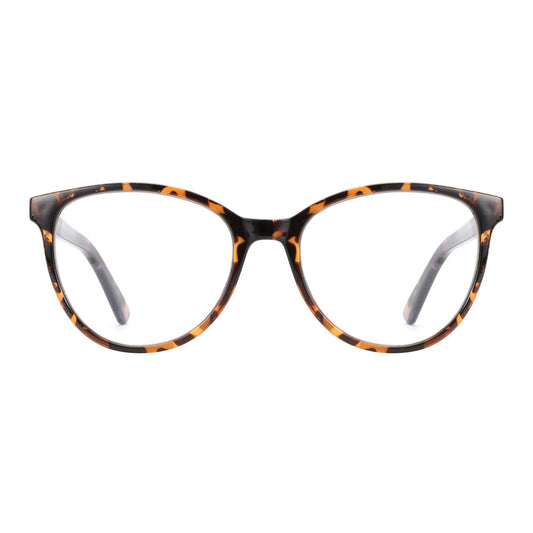
- Prioritize Frame Shape: Choose round or oval shapes; avoid sharp corners where thickness accumulates.
- Check the "Eye Size": Keep it as small as your face shape allows (typically under 50mm for high prescriptions).
- Verify PD: Ensure your pupillary distance is measured accurately (within 0.5mm).
- Select 1.67 or 1.74: Use 1.67 for value/clarity; 1.74 for maximum thinness.
- Request Aspheric Design: This reduces the "fishbowl" effect and improves the profile.
- Review our Technical Guide to High-Index Materials for more on MR-series polymers and durability.
By treating your eyewear as a precision-engineered tool, you can significantly reduce the weight and bulk of your glasses. Start by browsing our men’s eyeglasses or women’s eyeglasses with a focus on smaller, well-centered styles.
Important Vision Disclaimer: This guide provides engineering and cosmetic optimization strategies for eyewear. It is not medical advice. Lens thickness and visual comfort are subject to individual anatomy and prescription complexities. Always consult a licensed optometrist or ophthalmologist for eye health concerns or persistent visual discomfort.
