


How to Read a Prism Prescription: Correcting Double Vision
How to Read a Prism Prescription: Correcting Double Vision
Medical Disclaimer: This article is for informational purposes only and does not constitute medical diagnosis, treatment, or professional medical advice. Always seek the advice of a licensed optometrist, ophthalmologist, or other qualified vision care provider with any questions regarding a medical condition or vision correction.
Expert Review & Editorial Disclosure: This guide has been reviewed by the Zenottic Optical Engineering Team to ensure alignment with ANSI Z80.1-2025 standards. While this content is hosted by Zenottic, an eyewear provider, the technical recommendations are based on established optical heuristics and industry-standard manufacturing practices.
Summary
Reading a prism prescription involves identifying two key components: the prism power measured in diopters (indicated by a triangle symbol 'Δ' or 'Prism') and the base direction (Base In, Base Out, Base Up, or Base Down). This notation tells the optical laboratory where to position the thickest part of the lens to realign your vision. By bending light before it reaches the eye, prism lenses merge two separate images into one, providing relief from double vision (diplopia) and reducing the eye strain associated with binocular vision disorders.
Key Takeaways
- Prism Diopters (Δ): These measure the amount of light deviation required to align your eyes, rather than the magnification power of the lens.
- Base Notation: BI, BO, BU, and BD indicate the direction light is shifted, corresponding to the thickest edge of the lens geometry.
- Material Selection: High prism values often benefit from high-index lens materials to manage the increased edge thickness and weight caused by the lens's wedge-like shape.
- Adaptation Period: Most wearers require 2 to 4 weeks to adjust, during which a temporary "wobble" effect or spatial distortion is common.
- PD Accuracy: Precise Pupillary Distance (PD) is critical for prism users; even minor misalignments can introduce unwanted prismatic effects that may negate the corrective benefits.
Decoding the Prism Notation: What the Numbers and Directions Mean
When reviewing an eye prescription, you may be familiar with Sphere, Cylinder, and Axis. However, for those experiencing double vision or eye alignment issues, the section labeled "Prism" or denoted by a small triangle symbol (Δ) is the most critical. Unlike standard corrective powers that focus light onto the retina, prism diopters measure the degree to which light must be diverted to compensate for eye misalignment. For additional context on standard terms, you may find our comprehensive guide to reading a prescription for glasses helpful.
The prism value is always accompanied by a "Base" direction. This direction—Base In (BI), Base Out (BO), Base Up (BU), or Base Down (BD)—serves as a set of instructions for the optical laboratory. It specifies where the thickest part of the lens (the base) should be oriented. For instance, "Base In" means the thickest edge is toward the nose, while "Base Out" points toward the temples. These directions are precisely calculated to shift the incoming image so that it lands on the correct part of the retina in both eyes simultaneously, allowing the brain to fuse the input into a single, clear image.

Technical Note: Prism diopters are angular measurements of light deviation. This guide assumes the reader is using a valid prescription from a licensed Eye Care Professional (ECP).
The Physics of Diplopia: How Prism Lenses Realign Your World
Double vision occurs when the eyes are misaligned—a condition often related to strabismus or binocular vision dysfunction. In a healthy visual system, both eyes point at the same object, and the brain fuses these perspectives into one 3D image. When misaligned, the brain receives conflicting images, leading to diplopia, headaches, and fatigue. While standard lenses correct for myopia and hyperopia by changing focal points, they do not change the path of the light.

Prism lenses are wedge-shaped. As light passes through the thicker part of the wedge (the base), it bends toward that base. This shift moves the image to where the eye is actually positioned, rather than where it should be. This optical compensation relieves the extraocular muscles from the constant effort of pulling the eyes into alignment. Note that while prism corrects the symptom of double vision, it does not cure the underlying muscle imbalance; it provides a visual path that allows the user to function without the debilitating effects of diplopia.
Ground vs. Fresnel Prisms: Manufacturing Trade-offs
There are two primary ways prism correction is applied:
- Ground Prism: This is the standard for long-term wear. The correction is surfaced directly into the lens material during manufacturing, offering superior clarity and durability. However, as the diopter value increases, so does the lens thickness and weight. For prescriptions exceeding 5Δ or 6Δ, physical bulk can become a significant factor.
- Fresnel Prisms: These are thin, flexible plastic sheets pressed onto existing glasses. They use a series of tiny ridges to mimic light-bending properties without the weight. While useful for temporary prescriptions (e.g., during post-surgical recovery), they may reduce visual acuity and create "rainbow" effects or glare.
Managing Lens Thickness: The Role of High-Index Materials
Because a prism lens is thicker on one side, edge thickness can become pronounced, especially in larger frames. Using materials with a higher refractive index allows the lens to bend light more efficiently with less physical mass. As detailed in our Technical Guide to High-Index Lens Materials and Standards, material choice is a key factor in both comfort and aesthetics.
| Prism Power (Total Δ) | Recommended Lens Index | Primary Benefit |
|---|---|---|
| 0.5Δ to 2.0Δ | 1.50 or 1.57 Mid-Index | Standard thickness is typically acceptable. |
| 2.5Δ to 4.0Δ | 1.61 or 1.67 High-Index | Noticeable reduction in edge bulk and weight. |
| 4.5Δ and Above | 1.74 Super High-Index | Essential for managing high-prism wedge effects. |
Data Source & Scope: These recommendations are based on industry heuristics for common frame sizes (50-54mm). Larger frames or high-wrap styles will naturally result in thicker edges, potentially requiring a higher index even for moderate prism values.
For high-prism prescriptions, we often suggest 1.74 super high-index lenses. These materials are engineered to meet ANSI Z80.1-2025 standards, ensuring that even with complex surfacing, the lenses remain as thin as possible.
Strategic Frame Selection for High Prism Prescriptions
The frame you choose is as important as the lens material. To minimize the visible "base" edge, optical experts generally recommend:
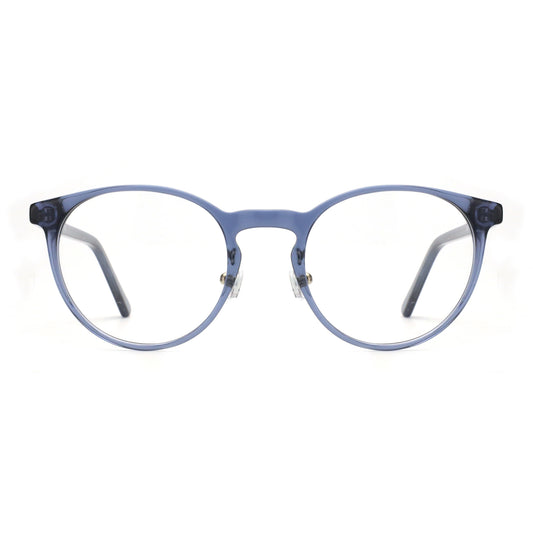
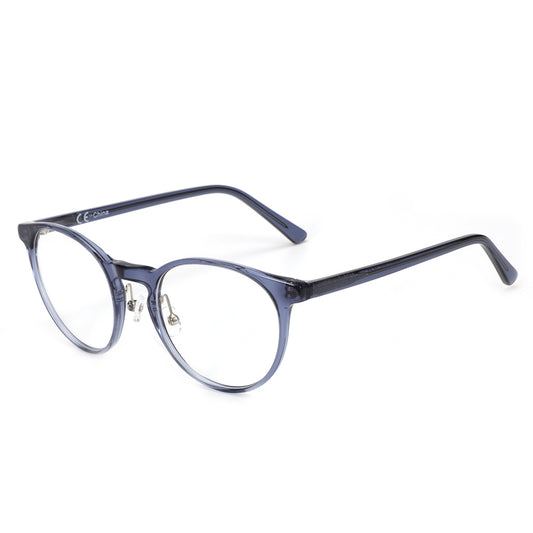
- Smaller, Rounded Shapes: Round or oval frames allow the lab to cut away the thickest parts of the lens blank. Large rectangular or aviator frames often retain the thickest portions at the corners.
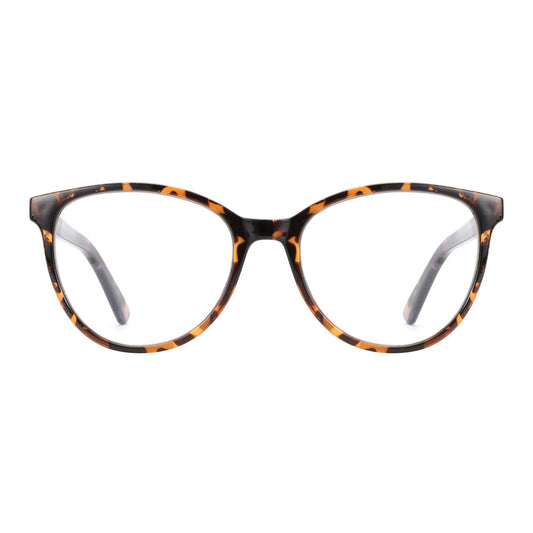
- Acetate Rims: Choosing from a wide selection of eyeglasses with thicker acetate (plastic) rims can help hide the edge of a prism lens. Metal frames have thin profiles that may leave the thick edge exposed.
- Vertex Distance: The space between the lens and your eye is vital. A frame that sits too far forward can increase the perceived "wobble" effect during the adaptation phase.
The Critical Role of Pupillary Distance (PD)
For a prism prescription, PD accuracy is paramount. Because prism lenses shift the image based on the optical center, any misalignment can introduce "unwanted prism," which may exacerbate double vision rather than correcting it.
Before ordering, it is highly recommended to measure your pupillary distance (PD) at home using high-precision digital tools or obtain the measurement from your doctor. Modern digital measurement tools often achieve the sub-millimeter accuracy required for complex binocular vision corrections.
Adaptation Protocols: Navigating the First 14 Days
Adapting to prism lenses is a unique process. Many users report a "wobble" effect where stationary objects seem to shift slightly. This occurs as the brain learns to interpret light that is bent before reaching the eye. Most patients require 14 to 28 days for their vision to stabilize.
Recommended Progressive Wear Schedule:
- Day 1-3: Wear the glasses for 2-4 hours in a familiar, low-activity environment (e.g., reading or watching TV).
- Day 4-7: Increase wear time to 6-8 hours. Avoid driving if you feel dizzy or experience spatial distortion.
- Day 8-14: Transition to full-day wear. The "wobble" should diminish as the brain's spatial mapping adjusts.
If you experience persistent nausea or if double vision does not resolve after three weeks, consult your optometrist for a professional evaluation.
FAQ
What does 'Base In' mean on my eye prescription? 'Base In' (BI) indicates the thickest part of the prism lens is positioned toward the nose. This is commonly prescribed for conditions like convergence insufficiency.
Can I read prism diopters on my Rx online? Yes, prism diopters are usually listed in a dedicated column marked with a 'Δ' symbol or 'Prism.' You will see a numerical value followed by the base direction (e.g., 2.00 BO).
Why do my new prism glasses make me feel dizzy? Dizziness is a common side effect during the first few days, often called the "wobble" effect. Your brain needs time to recalibrate its sense of space as the lenses shift the position of incoming light.
Is it possible to split the prism between both eyes? Yes, doctors often split a high prism prescription (e.g., 4.00Δ total) into 2.00Δ for each eye. This balances the weight and thickness of the lenses and can aid in adaptation.
Do prism lenses work for everyone? They are effective for double vision caused by eye misalignment (strabismus). They are generally not used for monocular diplopia (double vision in only one eye), which is typically caused by cataracts or corneal issues.
References
Government / Standards / Regulators
- ANSI Z80.1-2025: Ophthalmics - Prescription Ophthalmic Lenses
- ISO 8980-1:2026: Ophthalmic optics — Uncut finished spectacle lenses
Industry Associations / Research Institutes
- American Academy of Ophthalmology (AAO): What Is Prism Correction?
- American Optometric Association (AOA): Binocular Vision and Strabismus