



The Progressive Fit Guide: Choosing the Right Frame Height
Summary
Choosing the right frame height, technically known as the B-measurement, is the single most critical factor for ensuring success with progressive lenses. For standard multifocal designs in 2026, a minimum vertical height of 28mm to 30mm is recommended to accommodate the distance, intermediate, and reading zones without compromising visual clarity. While "short corridor" lenses allow for heights as low as 22mm, selecting a frame with adequate vertical space prevents the "cut-off" effect, where the reading area is too small or entirely lost at the bottom of the lens.
Key takeaways
- Minimum Height: Aim for a B-measurement of at least 28mm for standard progressives and 22mm for specialized short-corridor designs.
- Zone Allocation: Adequate height ensures that the transition from distance to reading vision is smooth and that the intermediate zone (for computer use) is usable.
- Fitting Parameters: Beyond height, factors like vertex distance and pantoscopic tilt significantly influence how the optical zones align with your pupils.
- Material Choice: Acetate frames often provide better stability for thicker multifocal lenses, while adjustable metal nose pads allow for fine-tuning the vertical position.
Understanding the B-Measurement: Why Vertical Height Matters
When you transition from single-vision glasses to progressives, the geometry of your lenses changes fundamentally. Unlike a single-vision lens that has one consistent power across its entire surface, a progressive lens is a feat of optical engineering that packs three distinct prescriptions into one piece of glass or polymer. The "B-measurement" refers to the vertical height of the lens opening in your frame, measured from the highest point to the lowest point.
In the world of online optical fulfillment, the B-measurement is often the "Technical Hook" that determines whether a wearer will adapt quickly or struggle with blurred vision. If a frame is too short, the laboratory must compress the corridor—the area where the power changes. This compression can lead to a narrow intermediate zone and a reading area that feels cramped or "cut off" by the bottom rim of the frame. Conversely, a frame with a generous B-measurement allows the lens designer to spread the power transition naturally, mimicking the way your eyes naturally move when shifting from the horizon to a book.
Logic Summary: This guide assumes the wearer has a standard pupillary distance and a typical facial structure. Recommendations are based on 2026 industry standards for digital lens surfacing. Individual adaptation may vary based on prescription strength and previous lens experience.
The Anatomy of a Progressive Lens: Mapping Your Vision Zones
To understand why height is so vital, we must look at how a progressive lens is mapped. The top portion is dedicated to distance vision—driving, watching television, or looking across a room. The middle section, known as the intermediate zone or corridor, provides the power needed for mid-range tasks like viewing a computer screen or a car's dashboard. Finally, the bottom portion contains the "add power" for reading and close-up work.

If you choose a frame that is too shallow, the reading zone may be positioned so low that it sits outside the physical boundary of the lens. This is a common technical failure in online orders where users prioritize style over optical requirements. When the reading zone is compromised, wearers often find themselves tilting their heads back uncomfortably to find the "sweet spot" for reading, leading to neck strain and "swim" effect—a sensation of peripheral distortion. For those exploring vision correction options, understanding this mapping is the first step toward a successful purchase.
Minimum Frame Height Standards for 2026
As of 2026, lens manufacturing technology has advanced significantly, allowing for more customization in shorter frames. However, the laws of physics still dictate that more vertical space generally equals a better visual experience. The following table outlines the current industry benchmarks for frame height based on lens type.
| Lens Type | Recommended B-Measurement | Minimum Threshold | Best Use Case |
|---|---|---|---|
| Standard Progressive | 28mm - 32mm | 26mm | General daily use, maximum comfort. |
| Short Corridor | 24mm - 26mm | 22mm | Small faces, narrow rectangular frames. |
| Premium Digital | 26mm - 30mm | 24mm | High-precision tasks, active lifestyles. |
| Office/Computer | 30mm+ | 28mm | Extended screen time, wide intermediate zone. |
When you browse our eyeglasses collection, you will notice that many modern designs are trending toward larger lens areas. This isn't just a fashion statement; it's a response to the growing demand for multifocal lenses that provide a wider, more natural field of view. For first-time wearers, we strongly suggest staying within the 28mm to 32mm range to ensure the easiest adaptation period.
Beyond the Ruler: How Vertex Distance and Tilt Affect Your View
While the B-measurement is a primary metric, it doesn't exist in a vacuum. Two other measurements—vertex distance and pantoscopic tilt—play a silent but crucial role in how those vertical zones align with your eyes. Vertex distance is the space between the back of the lens and the front of your cornea. If the glasses sit too far from your face, the usable field of view through the reading zone narrows, much like looking through a keyhole.
Pantoscopic tilt refers to the vertical angle at which the frame sits on your face. A slight inward tilt (toward the cheeks) is actually beneficial for progressives because it brings the reading zone closer to the eye's natural path when looking down. If a frame sits perfectly flat or tilts outward, the reading area becomes difficult to access. This is why adjustable nose pads are often recommended for multifocal wearers; they allow you to raise or lower the frame's position on your nose, effectively "tuning" the height of the vision zones. For more details on how these factors contribute to a perfect fit, refer to our proper eyewear fitting guide.
Material Matters: Choosing Between Acetate and Metal Frames
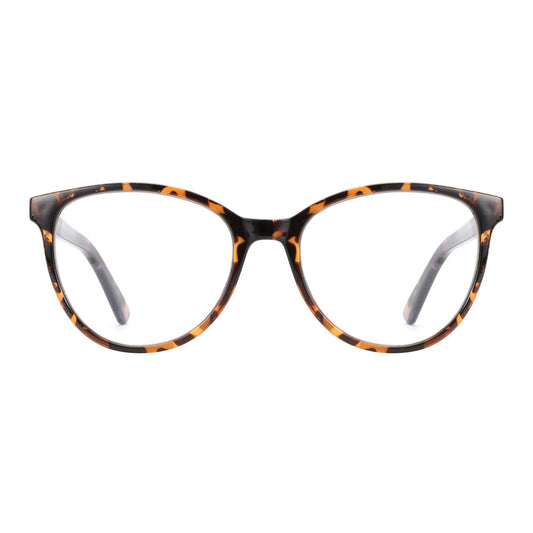
The material of your frame can influence how well it supports a progressive lens. Durable acetate frames are a popular choice for multifocals because they are generally sturdier and can hide the edge thickness of high-prescription lenses. Acetate also maintains its shape well, which is vital for keeping the optical centers of the lenses aligned with your pupils.
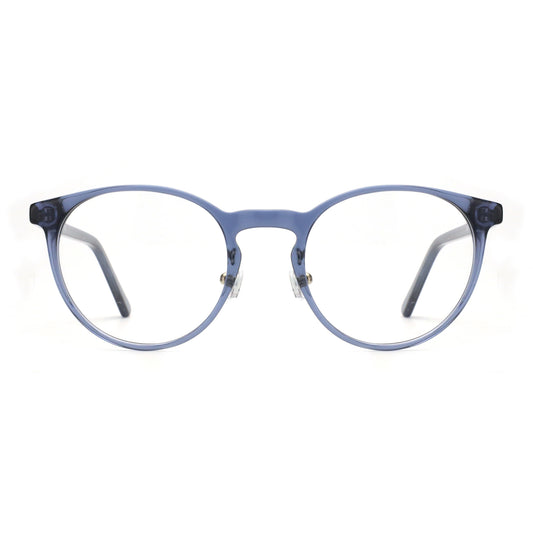
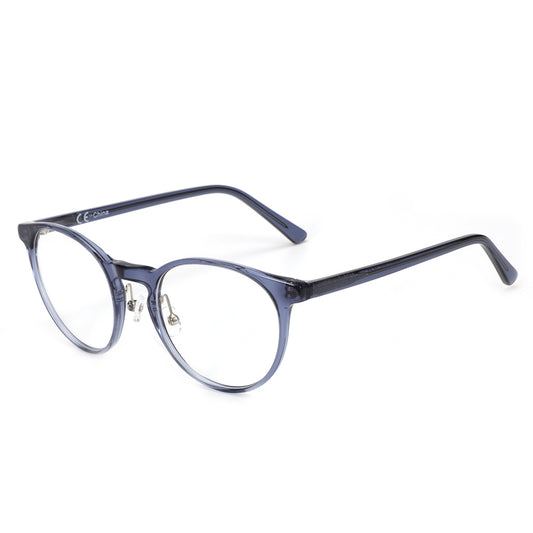
However, metal frames offer the advantage of adjustable nose pads. As mentioned, being able to adjust the vertical height of the frame on your nose can be a "life-saver" for progressive wearers. If you find that you have to tilt your head too far down to see your phone, a simple adjustment to the nose pads can lift the frame, bringing the reading zone higher up. When choosing frames for your face shape, consider whether you prefer the "set-it-and-forget-it" nature of acetate or the fine-tuned adjustability of metal.
For those with higher prescriptions, the choice of lens material is just as important as the frame. Our high-index lens materials guide provides a deep dive into the material science and manufacturing standards of high-index lenses, specifically focusing on the MR™ series polymers (1.61, 1.67, 1.74). This guide explains the critical relationship between refractive index and lens thickness, which can impact how a lens sits within a frame of a specific height.
Pre-Purchase Checklist: Verifying Your Frame Fit Online
Ordering progressives online can feel daunting, but following a structured verification process can eliminate most fitting errors. Before you click "buy," use this checklist to ensure your chosen frame is technically compatible with your prescription.
- Check the B-Measurement: Look for the "Lens Height" in the product specifications. Ensure it meets the 28mm minimum for standard lenses.
- Verify Your PD: Ensure you have a monocular Pupillary Distance (PD) measurement (one for each eye) rather than just a binocular average. This ensures the horizontal centers are perfect.
- Use Virtual Try-On: Many 2026 virtual try-on tools now include measurement overlays. Use them to see where the bottom of the frame sits relative to your cheekbones.
- Compare to Current Glasses: If you have a pair of glasses that fits well, measure their vertical height. If they are 25mm and you're struggling to read, aim for 30mm in your new pair.
- Review the Return Policy: Even with perfect measurements, adaptation can be subjective. Ensure the retailer offers a "Progressive Adaptation Guarantee."
Logic Summary: This checklist is designed to mitigate the "trust gap" in online optical fulfillment. It assumes the user has a valid, up-to-date prescription from a licensed optometrist.

FAQ
What is the absolute minimum frame height for progressive lenses? While some specialized "short corridor" lenses can be fitted into frames with a vertical height (B-measurement) as low as 22mm, most optical experts recommend a minimum of 28mm for a standard, comfortable experience. Choosing a height below 28mm often results in a narrower intermediate zone, which can make computer work more difficult. For the best balance of aesthetics and function, a height between 30mm and 34mm is considered the "gold standard" in 2026.
Can I put progressive lenses in any frame? Technically, most frames can hold a progressive lens, but not all frames should. Frames with very narrow vertical heights (like "half-moon" reading styles) or those with extreme "wrap" curvatures (like some sports sunglasses) are poor candidates for multifocals. The lens needs enough vertical "real estate" to transition through the different prescriptions. If the frame is too small, the most important part of your prescription—the reading area—might be cut off during the manufacturing process.
How do I measure my frame height (B-measurement) at home? To measure the B-measurement, use a millimeter ruler to measure the vertical distance of the lens opening at its widest point. Do not include the frame rim itself; measure only the space where the lens sits. It is best to measure from the inside of the frame's "groove" where the lens is inserted. If you are measuring an existing pair of glasses, measure the lens itself from top to bottom.
Why do my new progressives feel blurry at the bottom? Blurriness at the bottom of a progressive lens usually indicates that the reading zone is not aligned with your line of sight. This can happen if the frame height is too short, or if the glasses are sitting too low on your nose. Try pushing the glasses slightly higher up your nose bridge; if the clarity improves, the frame may need a nose pad adjustment. If the blurriness persists, the "segment height" (the vertical placement of the power change) may have been measured incorrectly.
What are short-corridor progressive lenses? Short-corridor progressives are specially designed lenses where the transition from distance to reading vision happens over a shorter vertical distance. These were developed to accommodate the fashion trend of smaller, narrower frames. While they allow for B-measurements as low as 22mm, the trade-off is often a more abrupt transition and a smaller intermediate zone. They are an excellent solution for those with small faces who cannot wear larger frames comfortably.
Does frame material affect progressive lens performance? Yes, frame material can impact both the fit and the optical stability. Acetate frames are excellent for hiding lens thickness and providing a stable platform for the lens, but they offer less adjustability. Metal frames, particularly those with adjustable nose pads, allow for fine-tuning the vertical position of the lens on your face, which can be crucial for aligning the vision zones. Titanium frames offer a lightweight alternative that combines durability with the adjustability of metal.
References
Government / Standards / Regulators
- ISO 8980-1:2025: Ophthalmic optics — Uncut finished spectacle lenses — Part 1: Specifications for single-vision and multifocal lenses. ISO Official Site
- ANSI Z80.1-2025: American National Standard for Ophthalmics — Prescription Spectacle Lenses. ANSI Webstore
Industry Associations / Research Institutes
- The Vision Council: Technical reports on lens processing and frame standards. The Vision Council
- American Optometric Association (AOA): Clinical guidelines for multifocal lens adaptation. AOA.org
Academic / Whitepapers / Labs
- Optical Engineering Journal: "Analysis of Corridor Length and Distortion in Modern Progressive Addition Lenses," 2024.
- Zenottic Technical Guide: Technical Guide to High-Index Lens Materials and Standards (Internal Reference).
Community (Intent Discovery Only)
- OptiBoard Discussion Forums: User experiences with short-corridor vs. standard progressives (Intent only; not authoritative).
- Reddit r/optometry: Common consumer complaints regarding online progressive lens orders (Intent only; not authoritative).
