




Do I Need Special Glasses for Astigmatism?
If you have astigmatism, you usually do not need a special type of eyeglass frame. What you need are prescription lenses crafted with the correct cylinder (CYL) and axis values from your optometry prescription. These precise measurements determine how much astigmatism correction you require and the exact angle at which that correction must sit. With an up-to-date prescription, you can freely choose frames based on fit, comfort, face shape, and the lens coatings that match your lifestyle.
What Is Astigmatism and How Does It Affect Your Vision?

Astigmatism is a widespread refractive error that occurs when the cornea or crystalline lens has an asymmetrical curvature. Instead of focusing light onto a single focal point on the retina, the eye refracts light unevenly across different meridians. This optical distortion causes images to appear blurred, shadowed, or stretched at both near and far distances.
Typical symptoms include squinting, digital eye strain, tension headaches, and poor night vision clarity. While people with mild astigmatism may notice minimal visual impairment, higher astigmatic corrections make night driving, reading fine text, and computer work difficult.
Astigmatism frequently coexists with myopia (nearsightedness) or hyperopia (farsightedness). The National Eye Institute notes that astigmatism is diagnosed during a comprehensive refractive eye exam and is effectively corrected using standard prescription lenses or toric contacts.
A professional eye exam remains the only reliable method to measure your refractive error and determine the exact lens powers needed for balanced vision.
Do I Need Specific Prescription Eyeglasses for Astigmatism?

You require specialized optical lenses configured for your astigmatism, but you do not need an unusual or dedicated frame design.
Most prescription eyeglasses for astigmatism look identical to standard optical prescription glasses. The key difference lies entirely within the customized lens curve. Your prescription directs the optical surfacing lab on how to align the directional curvature for sharp focus.
Depending on your daily visual demands, astigmatic correction can be integrated into:
- Single-vision lenses for dedicated distance, intermediate, or near viewing
- Progressive or multifocal lenses for seamless vision across all focal zones
- Reading lenses for close-up reading and detail tasks
- High-index lenses with cylinder correction to keep high-power prescriptions lightweight and thin
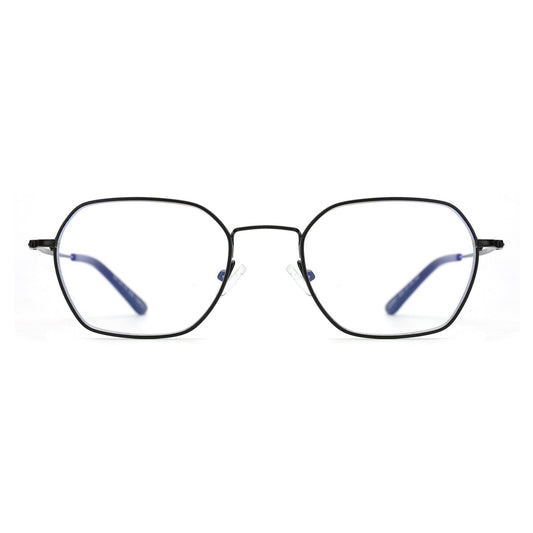
You can choose from full-rim acetate, titanium, geometric, square, or round frames, provided the frame size accommodates your pupillary distance and lens thickness.
When entering your order, ensure the CYL and AXIS values match your doctor's written prescription verbatim. Never guess or reuse expired numbers from older eyewear.
Understand Cylinder and Axis in Your Prescription
Deciphering the cylinder and axis parameters on your optical chart is simple once you understand the function of each column.
| Prescription Field | Clinical Function |
| SPH (Sphere) | Corrects spherical nearsightedness (-) or farsightedness (+) |
| CYL (Cylinder) | Quantifies the dioptric power needed to correct astigmatism |
| AXIS | Defines the orientation angle of cylinder correction (1° to 180°) |
Cylinder (CYL) is expressed in diopters with a plus (+) or minus (-) sign depending on whether your optometrist utilizes plus or minus cylinder convention. This number reflects the severity of the cornea's asymmetry.
Axis represents the rotational meridian where the cylindrical power is applied, measured in degrees from 1 to 180.
The axis number indicates the angle, not the severity of astigmatism. For instance, an axis of 180 degrees is not stronger than 90 degrees; it simply denotes a horizontal meridian rather than a vertical one.
A typical prescription entry reads:
SPH -2.00, CYL -1.00, AXIS 90
In this example, the lens corrects -2.00 diopters of myopia alongside a -1.00 diopter astigmatism correction oriented along the 90-degree meridian.
When ordering online, check your signs (+/-) and confirm that right eye (OD) and left eye (OS) values are entered into their corresponding fields.
How Toric Lenses Correct Astigmatism Effectively
Because astigmatic eyes refract light differently across horizontal and vertical axes, standard spherical lenses cannot bring all light rays into focus simultaneously. Corrective lenses resolve this by incorporating varying curvature across perpendicular meridians.
In ophthalmic optics, cylindrical and toric lens designs balance refractive power across different meridians of the lens to align the focal lines directly onto the retina.
While the term toric is commonly used to describe astigmatism-correcting contact lenses, eyeglass lenses achieve the same optical result through specialized CYL surfacing and AXIS positioning.
You do not need to calculate these parameters yourself. They are determined during your eye exam and translated directly onto your custom prescription lenses.
Choose the Best Frames for Your Astigmatism Prescription
Astigmatism does not restrict you to a single frame silhouette. An ideal frame must fit securely, distribute weight evenly, and align properly with your optical center. Keep the following guidelines in mind:
- Select proper frame proportions: The frame should sit securely on your nasal bridge without slipping. Stable alignment prevents axis rotation during head movements.
- Evaluate overall lens thickness: High CYL or high SPH values benefit from smaller, rounder, or full-rim acetate frames that conceal edge bevels and reduce overall weight.
- Ensure structural stability: Sturdy frame construction ensures that your lenses stay positioned at the prescribed vertex distance and pantoscopic tilt.
- Align with daily wear habits: All-day computer workers and drivers benefit from lightweight acetate or memory titanium frames fitted with anti-reflective coatings.
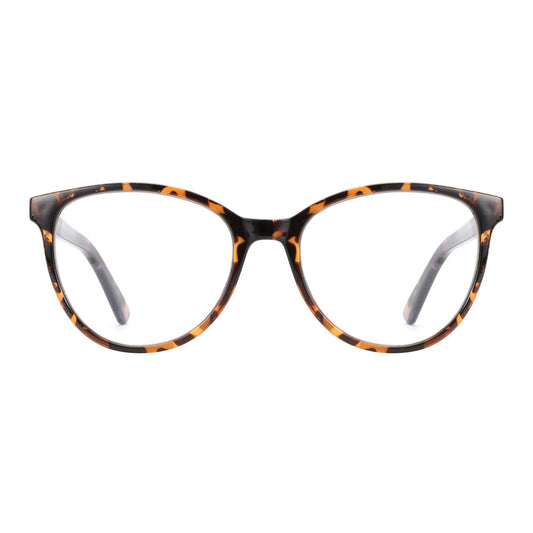
If you prefer a bold classic look for work and daily use, the Jacob prescription frame features a full-rim acetate silhouette that accommodates single-vision and progressive astigmatism lenses.
Check the frame's lens width, bridge width, and temple length to ensure the dimensions align with your facial measurements.
How to Order Eyeglasses for Astigmatism Online

Ordering astigmatism prescription eyeglasses online is quick and accurate when you have your complete doctor's prescription and pupillary measurements ready.
1. Prepare Your Current Written Prescription
Ensure your prescription is current and clearly lists SPH, CYL, and AXIS values for both eyes. Keep the document visible on your desk to avoid transcription errors.
2. Measure Your Pupillary Distance (PD)
Pupillary Distance (PD) measures the exact distance in millimeters between your pupil centers. Accurate PD is crucial because it ensures the optical center of the lens aligns directly with your visual axis, preventing unwanted induced prism distortion.
Remember that PD and AXIS are entirely different measurements; never substitute one value for the other.
3. Select a Compatible Frame
Compare frame width, bridge width, and temple length with a comfortable pair of glasses you currently own to guarantee an ergonomic fit.
4. Enter SPH, CYL, and AXIS Accurately
Assign OD to your right eye and OS to your left eye. Ensure that negative (-) and positive (+) signs are selected correctly. If CYL is present, the corresponding AXIS value must always be filled.
5. Choose Your Lens Index and Coatings
Select single-vision or progressive lenses, then pick your preferred lens index (e.g., 1.56, 1.61, or 1.67 high-index) and functional coatings like anti-reflective or blue-light-blocking filters.
Zenottic's prescription ordering guide outlines each step for configuring your custom lenses and entering optical numbers accurately.
6. Verify Your Order Summary
Perform a final review of your SPH, CYL, AXIS, PD, lens material, and frame style before checking out to eliminate potential data entry mistakes.
Clear, Comfortable Vision Tailored to Your Daily Style
Astigmatism does not require thick, awkward, or unconventional frames. As long as your lenses are accurately surfaced with your prescribed CYL and AXIS coordinates, you can wear any stylish frame that fits your face shape and personal aesthetic.
By obtaining an accurate prescription, measuring your pupillary distance, and choosing lightweight lens materials, you can enjoy crisp, distortion-free vision across all your daily activities.
Frequently Asked Questions
Can new astigmatism glasses feel strange at first?
Yes. Adjusting to a new cylinder or axis correction can cause mild spatial distortion, curved edges, or slight depth perception changes for 2 to 7 days. If eye strain, severe blur, or persistent headaches continue past two weeks, consult your eye care provider to verify the prescription.
Can the axis in my prescription change over time?
Yes. Minor changes in corneal curvature or natural lens changes can shift your axis over time. A shift in axis reflects a change in the meridian's angle rather than an increase in astigmatic severity.
Can I use my contact lens prescription to order eyeglasses?
No. Contact lenses sit directly on the cornea, whereas eyeglass lenses rest approximately 12 mm away from the eye (vertex distance). Because of this optical distance, contact lens and eyeglass prescriptions are not interchangeable.
Can prescription sunglasses correct astigmatism?
Yes. Prescription sunglasses can be crafted with your complete SPH, CYL, and AXIS values, combining sharp refractive correction with full UV protection and polarized glare reduction.
