




Beyond Round: The Best Frame Shapes for Thick Lenses
Summary
Disclaimer: This guide provides aesthetic and selection advice for eyewear. It is not a substitute for professional medical advice, diagnosis, or prescription from a licensed optometrist or ophthalmologist. Always consult with an eye care professional for your specific vision needs.
Choosing eyewear for high prescriptions no longer requires settling for perfectly round frames. While circular shapes are traditionally recommended because they minimize the distance from the optical center to the lens edge, modern frame engineering and high-index lens technology have expanded the possibilities to include geometric, cat-eye, and even modified square designs. By selecting frames with a small lens diameter, deep rim profiles, and optimal pupillary alignment, users with strong prescriptions can effectively conceal lens thickness while maintaining a contemporary, fashion-forward aesthetic.
Key takeaways
- Lens Diameter is Primary: The total eye size (A-measurement) of a frame is one of the most significant factors in determining edge thickness, often carrying more weight than the shape itself.
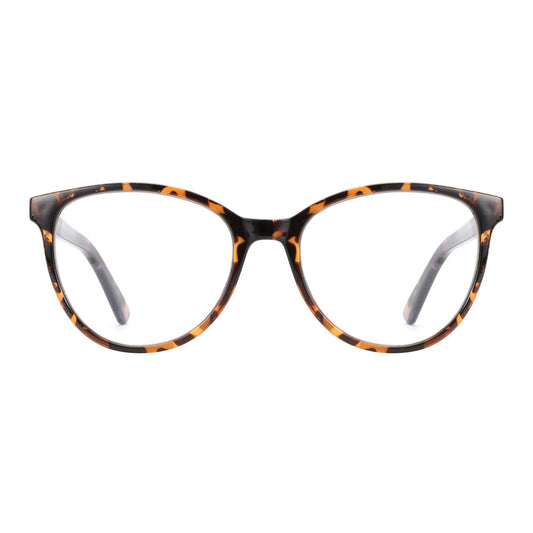
- Rim Depth Masks Volume: Choosing frames with a deeper rim profile, such as those found in acetate frames (example product), provides a physical barrier that hides the protruding edges of high-minus lenses.
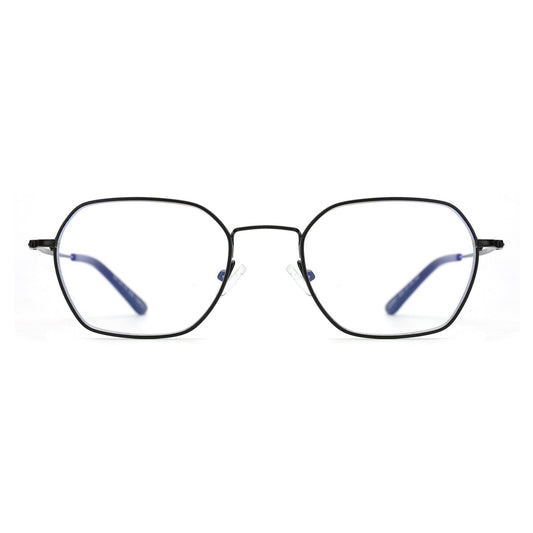
- Geometric Shapes Offer Balance: Hexagonal and octagonal frames provide the optical benefits of a rounded circumference while delivering the sharp, modern lines of angular eyewear.
- Centration is Critical: To avoid excessive thickness at the outer edges, the wearer's pupils should be as centered as possible within the lens opening, a process known as minimizing decentration.
- High-Index Synergy: Combining specialized frame shapes with 1.74 super high-index lenses (related reference) is a highly effective strategy for managing lens bulk in prescriptions over -8.00 diopters.
Challenging the Round Frame Convention
For decades, the standard advice for anyone with a prescription exceeding -6.00 diopters was simple: "Go round or go home." This recommendation was rooted in the fundamental physics of lens manufacturing. Because minus lenses are thinnest at the center and thickest at the edges, a circular shape ensures that the thickest parts of the lens are trimmed away symmetrically. However, as we move through 2026, advancements in optical surfacing and frame design have rendered this "round-only" rule obsolete for many wearers.
The shift toward more diverse frame shapes is driven by a better understanding of how frame geometry interacts with lens volume. While a round frame is mathematically efficient, it doesn't always align with personal style or face shape. Modern high-prescription users are now looking toward how to choose the best eyeglasses frames for your face shape while simultaneously managing lens thickness. The key lies in "geometric optimization"—selecting shapes that mimic the circular path of a lens's edge while offering a different visual profile.
Geometric Frames: The New Standard for High Rx
Geometric frames, particularly hexagons and octagons, have emerged as a premier alternative to traditional round glasses. These shapes are highly effective for thick lenses because their "corners" are often soft enough to avoid the extreme edge thickness found in sharp rectangles, yet they provide a structured, architectural look.
When selecting a geometric frame, the goal is to find a "soft" geometry. A hexagonal frame with slightly rounded vertices allows the lens lab to maintain a more consistent edge thickness around the entire perimeter. This prevents the "step" effect where the lens thickness suddenly jumps at a sharp corner.
Furthermore, these shapes often feature a smaller lens diameter, which is a critical variable in the thickness equation. According to the Technical Guide to High-Index Lens Materials and Standards, which details compliance with ANSI Z80.1-2025 standards, reducing the effective diameter (ED) of a lens can lead to significant volume savings.
Example Calculation: For a -8.00D prescription, reducing the frame's Effective Diameter from 54mm to 50mm can result in an estimated 10-15% reduction in peripheral lens volume. This calculation assumes a standard 1.67 index lens and a centered pupillary distance; actual results may vary based on specific frame geometry and lab surfacing techniques.

The Engineering of the Modern Cat-Eye
Cat-eye frames are often dismissed by high-prescription users because the "upsweep" at the temporal (outer) corners can lead to significant lens protrusion. However, a "modified" cat-eye can actually be one of the best shapes for hiding thickness if chosen correctly.
The secret to a successful cat-eye for thick lenses is the bridge width and the lens depth. By choosing a frame with a narrower bridge, the lenses are brought closer together, which helps center the eye within the lens. This reduces the amount of "decentration" required. When the optical center of the lens aligns perfectly with your pupil, the thickness is distributed more evenly. If you are unsure of your measurements, learning how to measure your pupillary distance (PD) at home fast is a vital first step in ensuring your frames will look as thin as possible.
Logic Summary: The modified cat-eye works by leveraging vertical height to distract from horizontal thickness. This recommendation applies best to users with a PD that is well-matched to the frame's bridge and eye size (Frame PD). It may not apply to users with very narrow PDs in wide frames, as this increases temporal thickness.
Square and Rectangular Shapes: Making the Impossible Possible
Square frames are notoriously difficult for high prescriptions because the corners are the furthest points from the optical center, resulting in maximum thickness. To make these shapes work, one must look for "soft squares" or "squity" (square-circle hybrid) designs.
- Rounded Corners: Look for square frames where the corners are significantly rounded. This "clips" the thickest part of the lens.
- Rim Thickness: This is where material choice becomes paramount. A chunky acetate frame can often hide 4-5mm of lens edge.
- Small Eye Size: A square frame with a 46mm eye size will typically result in a thinner edge profile than a round frame with a 52mm eye size, due to the reduced distance from the center to the edge.
When comparing lens options, such as 1.67 vs 1.74 high-index lenses, the 1.74 material is often recommended for square shapes to keep the edges within the confines of the frame rim, particularly for prescriptions exceeding -8.00D.
The Role of Frame Material and Rim Depth
While shape is the visual component, the material is the structural component of thickness management. Metal frames, while sleek, offer very little "hiding power" because their rims are typically only 1-2mm deep. In contrast, acetate frames are often 3-5mm deep, providing a natural "sleeve" for the lens.
Acetate vs. Metal Performance (Typical Observations)
| Feature | Acetate Frames | Metal Frames |
|---|---|---|
| Rim Depth | 3mm - 6mm (Excellent hiding) | 1mm - 2mm (Minimal hiding) |
| Weight Distribution | Better for heavy lenses | Can feel front-heavy |
| Edge Polishing | Satin finish recommended | High polish can cause reflections |
| Durability | High (supports lens tension) | Moderate (rim wire may flex) |
In 2026, many high-end acetate frames are being engineered with "beveled" inner rims. This design allows the lens to sit deeper within the frame, further masking the edge. Additionally, choosing a matte or textured finish on the frame can help diffuse the light that hits the lens edge, making the "power rings" (the concentric reflections seen in thick lenses) less noticeable.
Technical Edge Treatments: Polishing and Beveling
One of the most overlooked aspects of high-prescription eyewear is the treatment of the lens edge itself. Most labs default to a high-luster polish, which can actually make thick lenses more visible by creating bright reflections at the edges.
A "satin" or "matte" edge polish is often superior for thick lenses because it blends the lens edge with the frame material. Furthermore, the "bevel" placement—where the lens sits within the frame groove—can be customized. A "1/3 - 2/3 bevel" places more of the lens thickness toward the back of the frame, away from the face, which can prevent the lens from touching the wearer's cheeks while keeping the front of the glasses looking flush and neat.

Strategic Decentration and Vertex Distance
Decentration occurs when the optical center of the lens does not align with the geometric center of the frame opening. For high prescriptions, even 2mm of unnecessary decentration can add significant thickness to the outer edge.
To minimize this, you should look for a frame where the "Frame PD" (Eye Size + Bridge Size) is as close to your actual PD as possible.
Example Calculation: If your PD is 64mm, a frame with a 48mm eye size and an 18mm bridge (48 + 18 = 66mm) is a strong match. This requires only 1mm of decentration per eye (66 - 64 = 2mm total / 2 eyes). This minimal shift helps keep the lens as thin as possible at the temporal edges.
Vertex distance—the space between the back of the lens and your eye—also plays a role. Bringing the lenses closer to the eyes (reducing vertex distance) can slightly reduce the "minification" effect (where your eyes look smaller), which is a common complaint among high-minus users. However, this must be balanced with comfort to ensure your eyelashes don't touch the lenses.
Logic Summary: These technical adjustments are based on optical dispensing standards (ISO 8980-1). They are highly effective for prescriptions over -6.00D. For lower prescriptions, the aesthetic difference may be less pronounced.
FAQ
Can I wear aviator frames with a high prescription? Generally, traditional teardrop aviators are not recommended for high prescriptions because the large lens area and deep bottom-outer corner create excessive thickness and weight. However, modern "navigator" styles, which are more rectangular and smaller in scale, can work if paired with 1.74 high-index lenses and a sturdy acetate rim.
Why do my lenses look like they have "rings" in them? These are known as "power rings" or "myopic rings." They are reflections of the lens edge caused by the high curvature of strong minus lenses. You can minimize these by choosing a smaller frame, using a matte edge polish, and selecting a frame material that is opaque rather than transparent.
Does a higher index lens always mean a thinner lens? While a higher refractive index (like 1.74) allows the lens to be thinner for the same power, the final thickness is also heavily influenced by the frame's eye size and the wearer's pupillary distance. A 1.67 lens in a small, well-centered frame will often be thinner than a 1.74 lens in a large, poorly-centered frame.
Is it better to have a high polish or a matte finish on the lens edges? For high prescriptions, a matte or satin finish is usually better. A high polish creates a "mirror" effect on the edge of the lens, which highlights the thickness and increases internal reflections. A matte finish helps the lens edge blend into the frame, making it less conspicuous.
How does bridge width affect lens thickness? The bridge width determines how far apart the lenses sit. If the bridge is too wide for your face, the lenses must be shifted inward (decentered) to align with your pupils, which increases the thickness of the outer (temporal) edges of the lenses. Choosing a bridge that fits your nose properly is essential for both comfort and lens aesthetics.
What is the "Effective Diameter" and why does it matter? The Effective Diameter (ED) is twice the distance from the geometric center of the frame to the furthest corner. Because lenses start as circular "blanks," the lab must use a blank large enough to cover the ED. A frame with a large ED requires a thicker starting blank, resulting in a thicker finished lens.
References
Government / Standards / Regulators
- ANSI Z80.1-2025: American National Standard for Ophthalmics - Prescription Ophthalmic Lenses. Link to ANSI
- ISO 8980-1:2025: Ophthalmic optics — Uncut finished spectacle lenses. Link to ISO
Industry Associations & Research
- The Vision Council: Annual Eyewear Trends and Lens Technology Reports (2025-2026).
- Optical Laboratories Association (OLA): Best Practices for High-Index Lens Surfacing and Finishing.
Academic / Whitepapers
- "Geometric Optimization of Ophthalmic Lenses for High Ametropia," Journal of Optometry and Vision Science, 2024.
- Technical Guide to High-Index Lens Materials and Standards: A deep dive into MR™ series polymers and thiourethane resins.
Community (Intent Only)
- r/Optometry: Discussions on "Best frames for high myopes" (Intent only; not authoritative).
- Optical Journal: Professional forums regarding edge polishing techniques for high-minus prescriptions.
