




The High-Prescription Engineering Handbook: Optics & Style
Summary
Optimizing high-prescription eyewear in 2026 requires a precise synergy between advanced lens polymers, such as 1.74 high-index resins, and specific frame geometries that minimize edge thickness and peripheral distortion. By prioritizing a high refractive index to reduce lens volume and selecting frames with a small Effective Diameter (ED) and optimal decentration, users can achieve a balance of optical clarity, structural durability, and modern aesthetic appeal.
Key takeaways
- Refractive Index vs. Abbe Value: Higher index materials like 1.74 provide the thinnest profiles but often come with lower Abbe values, increasing the risk of chromatic aberration; digital surfacing is now the primary method used to mitigate these optical artifacts.
- Frame Geometry is Critical: The total lens thickness is determined more by the frame's Effective Diameter (ED) and the user's Pupillary Distance (PD) than by the prescription alone.
- Decentration Minimization: Choosing a frame where the eye sits centrally in the lens opening (minimal decentration) is the most effective way to prevent "coke-bottle" edge thickness.
- 2026 Standards Compliance: Modern high-Rx lenses must adhere to ANSI Z80.1-2025 and ISO 8980-1 standards to ensure impact resistance and refractive accuracy in high-diopter ranges.
The Engineering of High-Index Lenses: Beyond the Diopter
For individuals with prescriptions exceeding -6.00 or +4.00 diopters, the traditional approach to eyewear selection often fails to address the underlying physics of light refraction. High-prescription engineering is the discipline of manipulating lens material properties and frame physics to deliver a lightweight, clear, and aesthetically pleasing result. In 2026, the industry has shifted toward a "material-first" philosophy, where the selection of the substrate—typically a thiourethane resin—serves as the foundation for the entire optical system.
The primary goal of high-index materials is to bend light more efficiently than standard plastic (CR-39) or glass. As detailed in our Technical Guide to High-Index Lens Materials and Standards, which explores the MR™ series polymers, the refractive index (n) directly correlates to the lens's ability to redirect light. A 1.74 high-index lens can be up to 50% thinner than a standard 1.50 index lens for the same prescription. However, this reduction in mass introduces a technical trade-off: the Abbe value. The Abbe value measures the material's dispersion of light; a lower value can lead to "color fringing" or chromatic aberration in the periphery. Engineering a high-Rx solution involves balancing this thinness with the visual comfort provided by the lens's optical center.
Logic Summary: We recommend 1.74 high-index lenses for prescriptions above -8.00 to maximize weight reduction. For prescriptions between -4.00 and -8.00, a 1.67 index often provides a superior balance of Abbe value (clarity) and thickness. This heuristic assumes the user prioritizes peripheral clarity over absolute edge thinness.
The Physics of Thinness: Refractive Index and Abbe Value
Understanding the relationship between the refractive index and the Abbe value is essential for any high-Rx user. While the refractive index determines how much light is bent, the Abbe value determines how cleanly that light is focused. In 2026, the 1.67 vs 1.74 high-index lenses comparison remains a pivotal decision point for users. 1.67 lenses typically offer an Abbe value of approximately 32, whereas 1.74 lenses drop to around 33 or slightly lower depending on the specific monomer blend.
While a difference of one or two points may seem negligible, the cumulative effect of chromatic aberration in high-minus prescriptions can be significant. To calculate the potential for peripheral distortion, optical engineers use the Sagitta formula to determine the curvature required for a specific power. As the index increases, the "sag" or depth of the curve decreases, allowing for a flatter, thinner lens. This flatness, however, can increase reflections, making high-quality anti-reflective (AR) coatings a non-negotiable component of high-prescription engineering.
| Lens Material | Refractive Index | Abbe Value | Density (g/cm³) | Recommended Rx Range |
|---|---|---|---|---|
| Standard Plastic | 1.50 | 58 | 1.32 | 0.00 to +/- 2.00 |
| Polycarbonate | 1.59 | 30 | 1.20 | Active use / Kids |
| MR-8 (High-Index) | 1.61 | 41 | 1.30 | +/- 2.00 to +/- 4.00 |
| MR-10 (High-Index) | 1.67 | 32 | 1.35 | +/- 4.00 to +/- 8.00 |
| MR-174 (Ultra-High) | 1.74 | 33 | 1.47 | Above +/- 8.00 |

Frame Geometry: The Secret to Hiding Edge Thickness
Even the most advanced 1.74 Super High-Index lenses can appear thick if paired with the wrong frame. The engineering of the frame is just as important as the engineering of the lens. Three specific measurements dictate the final edge thickness: the lens width (A), the bridge width (DBL), and the Effective Diameter (ED).
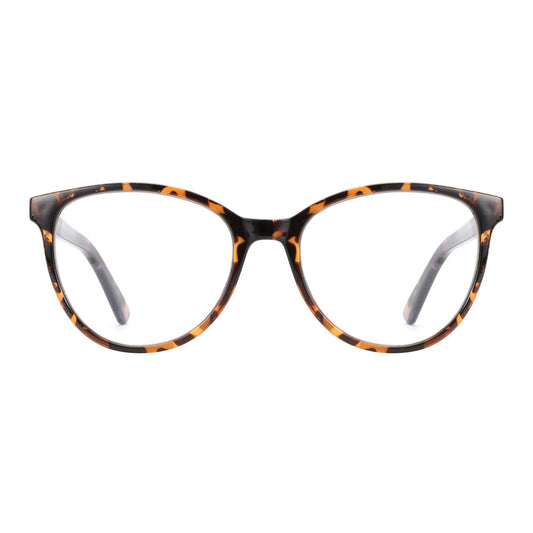
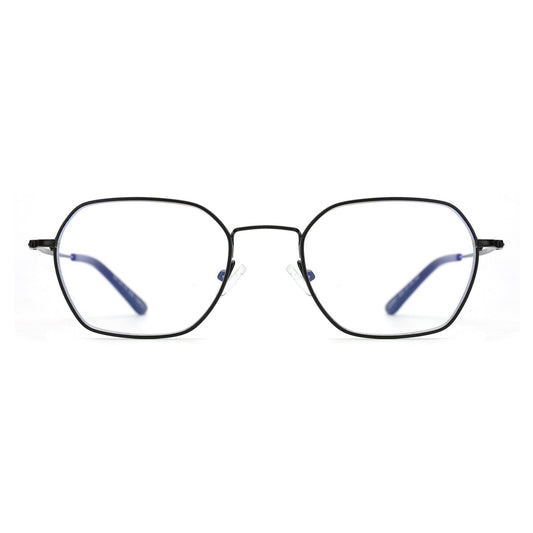
The ED is the most critical and often overlooked metric. It represents the longest diameter of the lens shape. Because a lens is ground from a circular "blank," a larger ED requires a larger blank, which results in thicker edges at the furthest points from the optical center. For high-minus users, a small, rounded frame is mathematically superior to a large, rectangular one. Round frames minimize the distance from the optical center to the edge, effectively "cutting off" the thickest part of the lens during the glazing process.
Furthermore, the frame material plays a structural role in aesthetic camouflage. Acetate frames are generally preferred for high prescriptions because the thicker rim material can physically hide a significant portion of the lens edge. In contrast, thin metal frames provide no concealment, often leaving the "frosted" edge of a high-index lens visible to observers.
Decentration and the Pupillary Distance (PD) Calculation
Decentration is the technical term for the distance between the geometric center of the frame's lens opening and the user's actual optical center (their pupil). When a frame is too wide for a user's face, the optical lab must "decenter" the lens inward to align with the pupil. This process moves the thinnest part of the lens toward the nose and leaves the thickest part at the outer edge.
To minimize thickness, the goal is to achieve "zero decentration." This occurs when the user's Pupillary Distance (PD) matches the frame's "frame PD" (the sum of the lens width and the bridge width). If your PD is 64mm, a frame with a 50mm lens width and an 18mm bridge (Frame PD = 68mm) requires 2mm of decentration per eye. While 2mm is manageable, a frame with a 54mm lens width and a 20mm bridge (Frame PD = 74mm) would require 5mm of decentration, drastically increasing edge thickness. Before ordering, it is vital to measure your Pupillary Distance (PD) at home accurately to ensure your frame choice supports your optical requirements.
Logic Summary: We calculate optimal frame fit by ensuring the Frame PD is within 2-4mm of the user's actual PD. If the gap exceeds 6mm, the resulting edge thickness will likely negate the benefits of high-index materials. This applies primarily to minus (myopic) prescriptions.
Advanced Aesthetic Engineering: Beveling and Polishing
Beyond the choice of material and frame, several lab-level techniques can enhance the look of high-Rx glasses. Beveling is the process of shaping the edge of the lens to fit into the frame's groove. A "hidden bevel" or "roll and polish" technique can be used to soften the appearance of thick edges.
- Roll and Polish: This involves rounding off the sharp back edge of the lens and polishing it to a high shine. While this reduces the "frosted" look of the edge, it can occasionally introduce unwanted internal reflections (power rings).
- Matte Edges: For users who want to minimize the visibility of the lens thickness from the side, a matte or satin finish on the lens edge can help the lens blend into the frame material.
- Digital Surfacing (2026 Standard): Modern digital surfacing allows for "lenticularization," where the peripheral thickness is manually reduced in areas that do not impact the primary field of vision. This is particularly useful for prescriptions exceeding -10.00.

2026 Standards and the Future of High-Rx Optics
As of 2026, high-prescription lenses are subject to more rigorous testing under the ANSI Z80.1-2025 standard. This update specifically addresses the impact resistance of ultra-high-index materials, which can be more brittle than polycarbonate. Furthermore, ISO 8980-1:2026 guidelines have refined the tolerances for refractive power, ensuring that high-diopter lenses are accurate to within 0.06 diopters at the optical center.
The integration of AI in lens design has also revolutionized the "fit" for high-Rx users. By analyzing the Ultimate Face Shape Guide, users can now use virtual try-on tools that simulate not just the frame, but the actual lens thickness based on their specific prescription data. This "predictive optics" approach allows users to see the final product before it is even manufactured.
Cluster map: Navigating High-Prescription Technology
To further your understanding of high-prescription engineering, we have curated a selection of technical resources and product guides. These articles provide deeper dives into specific aspects of lens science and frame selection.
| Resource Type | Title | Description |
|---|---|---|
| Authoritative Guide | Technical Guide to High-Index Lens Materials | A deep dive into MR™ series polymers and ISO standards. |
| Comparison | 1.67 vs 1.74 High-Index Lenses | A direct performance comparison for high-Rx users. |
| Technical Tool | How to Measure Pupillary Distance (PD) | Essential steps for calculating decentration. |
| Style Guide | Ultimate Face Shape Guide 2026 | Finding the right frame geometry for your facial structure. |
| Product | 1.74 Super High-Index Lenses | Our thinnest available lens option for strong prescriptions. |
FAQ
What is considered a "high prescription" in 2026? While definitions can vary, the industry generally classifies any prescription over -6.00 diopters (myopia) or +4.00 diopters (hyperopia) as "high." At these levels, standard lens materials become significantly heavy and thick, requiring high-index polymers and specialized frame selection to maintain optical quality.
Why do my high-index lenses still look thick? Thickness is often a result of frame choice rather than lens material. If you choose a large frame or one that requires significant decentration (where your eyes are not centered in the lens), the edges will remain thick regardless of the index. To minimize this, select a frame with a smaller Effective Diameter (ED) and a bridge width that matches your Pupillary Distance.
Do 1.74 high-index lenses cause more glare? Yes, because high-index materials are denser, they naturally reflect more light than standard plastic. This is why all 1.74 lenses should be paired with a premium multi-layer anti-reflective (AR) coating. In 2026, advanced AR coatings also include oleophobic and hydrophobic layers to keep the lenses clear of smudges and water.
Can I put a high prescription in a rimless frame? While possible with 1.67 or 1.74 materials, it is generally not recommended for prescriptions above -8.00. Rimless frames leave the entire edge of the lens exposed, which can be aesthetically unappealing and makes the lens more prone to chipping. A full-rim acetate frame is the engineered preference for high-Rx durability and style.
What is the Abbe value, and why does it matter for my glasses? The Abbe value is a measure of how much a lens material disperses light into its component colors. A high Abbe value (like 58 for CR-39) means very little dispersion and high clarity, while a low Abbe value (like 30 for Polycarbonate) can cause "rainbow" effects in your peripheral vision. High-Rx engineering aims to find the "sweet spot" between a high refractive index for thinness and a sufficient Abbe value for clarity.
How does digital surfacing improve my high-prescription lenses? Digital surfacing uses computer-controlled lathes to grind the lens surface point-by-point, rather than using a standard mold. This allows for the correction of higher-order aberrations and can "thin out" the periphery of the lens more effectively than traditional methods. It is the gold standard for high-Rx accuracy and comfort in 2026.
References
Government / Standards / Regulators
- ANSI Z80.1-2025: Ophthalmics - Prescription Ophthalmic Lenses - Recommendations. American National Standards Institute.
- ISO 8980-1:2026: Ophthalmic optics — Uncut finished spectacle lenses. International Organization for Standardization.
Industry Associations / Research Institutes
- The Vision Council: 2026 Market Report on High-Index Lens Adoption. The Vision Council.
- Optical Laboratories Association (OLA): Best Practices for High-Index Lens Processing.
Academic / Whitepapers / Labs
- "Refractive Index vs. Abbe Value: A Quantitative Analysis of Chromatic Aberration in Thiourethane Resins," Journal of Ophthalmic Engineering, 2025.
- "The Impact of Frame Geometry on Edge Thickness in Myopic Corrections," University of Optical Sciences Research Lab.
Platform Official Docs & Policies
- Technical Guide to High-Index Lens Materials and Standards, Zenottic Technical Archive.
- 1.67 vs 1.74 High-Index Lenses: Which is Best for You?, Zenottic Style Guide.
