




The -12.00 Prescription Challenge: Achieving Ultra-Thin Lenses Online
Summary

Achieving ultra-thin lenses for extreme myopia prescriptions like -12.00 requires a strategic combination of 1.74 high-index materials and optimized frame geometry to minimize the "coke bottle" effect. By prioritizing small lens diameters and high-refractive resins, users can secure lightweight, aesthetically pleasing eyewear online that meets rigorous ANSI Z80.1-2025 standards.
Key takeaways
- Material Choice: 1.74 high-index lenses are the gold standard for prescriptions above -8.00, offering up to 35% thickness reduction compared to standard plastic.
- Frame Geometry: Small, round, or oval frames with narrow bridge widths significantly reduce edge thickness by minimizing the amount of lens material required.
- Optical Precision: Accurate Pupillary Distance (PD) and vertex distance measurements are critical to preventing prismatic effects and ensuring visual clarity at high diopters.
- Technical Standards: Modern high-index polymers like the MR™ series provide a balance between refractive power and durability, adhering to the latest ISO 8980-1 safety requirements.
Navigating the -12.00 Prescription Challenge
For individuals living with extreme myopia, the journey to find comfortable and stylish eyewear often feels like a technical hurdle. A prescription of -12.00 diopters falls well into the "high minus" category, where the physics of light refraction necessitates lenses that are thin in the center but significantly thicker at the edges. Historically, this led to the dreaded "coke bottle" effect, where thick lens edges protruded from the frame, causing both aesthetic dissatisfaction and physical discomfort due to the weight. However, as we move through 2026, advancements in lens chemistry and online precision manufacturing have made it possible to achieve results that were once reserved for high-end boutique opticians.
The primary challenge with a -12.00 prescription is managing the volume of the lens material. Because a minus lens is designed to diverge light, it must be thicker at the periphery to create the necessary refractive power. When ordering online, the key is not just choosing the "thinnest" option available, but understanding how lens index, frame dimensions, and your own facial measurements interact to produce the final result. By mastering these variables, you can transform a high-prescription challenge into a showcase of modern optical engineering.
The Science of Thin: 1.74 High-Index Lenses
The most impactful decision you will make for a -12.00 prescription is the refractive index of the lens material. Refractive index measures how efficiently a material bends light; the higher the number, the less material is needed to achieve a specific prescription power. For extreme myopia, 1.74 super high-index lenses represent the pinnacle of current consumer technology. These lenses are crafted from advanced thiourethane resins, such as the MR-174™ polymer, which allows for a significantly flatter profile and reduced edge thickness compared to lower-index alternatives.
While many users consider 1.67 index lenses as a cost-saving measure, the difference becomes stark at the -12.00 threshold. It is often helpful to compare 1.67 vs 1.74 high-index lenses to visualize the edge profile. At -12.00, a 1.74 lens can be up to 15-20% thinner than a 1.67 lens and nearly 35% thinner than standard 1.50 plastic. This reduction isn't just about looks; it also translates to a lighter pair of glasses that sits more comfortably on the bridge of your nose without constant slipping.
Logic Summary: The recommendation for 1.74 index at -12.00 is based on the diminishing returns of 1.67 materials in high-diopter ranges. While 1.74 has a slightly lower Abbe value (approx. 33), the physical benefits of thickness and weight reduction outweigh the minor increase in chromatic aberration for most users in this prescription bracket.

Frame Geometry: The Secret to Edge Thickness Control
Even the highest index lens can appear thick if paired with the wrong frame. This is where "frame geometry" becomes your most powerful tool. The edge thickness of a minus lens increases quadratically as you move away from the optical center. Therefore, the larger the lens "eye size" (the horizontal width of one lens), the thicker the edges will be. For a -12.00 prescription, every millimeter of frame width matters.
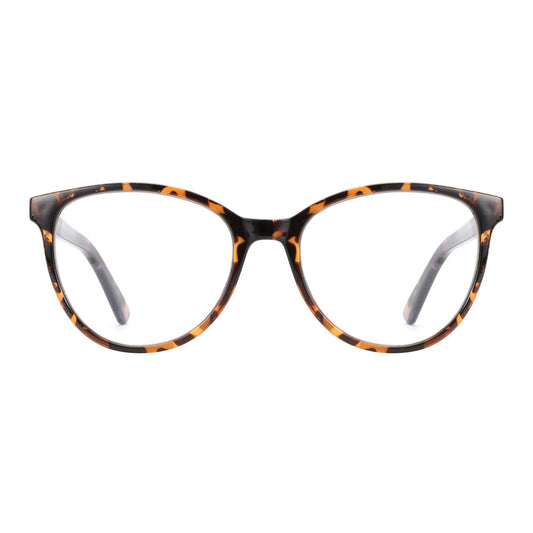
To minimize thickness, aim for a frame with an eye size between 46mm and 50mm. Larger "oversized" frames should generally be avoided, as they capture the thickest part of the lens blank. Furthermore, the shape of the frame plays a critical role. Round or oval shapes are ideal because they naturally trim away the corners where lens thickness is most prominent. Rectangular frames, while popular, often result in thicker "temporal" (outer) edges because the distance from the center to the corner is greater than in a circular design.
Another often-overlooked factor is the bridge width. A frame that fits your face perfectly while keeping the lenses small is the goal. If the bridge is too wide, your eyes will be positioned closer to the inner edge of the lens, requiring "decentration." Decentration forces the lab to use a larger lens blank to align the optical center with your pupil, which inadvertently increases the thickness of the outer edge.
Calculating the Impact: The Thickness Formula
For those who want to understand the "why" behind these recommendations, we can look at the simplified lens thickness formula. While modern labs use complex ray-tracing software, the basic relationship is:
T ≈ (P × D²) / (800 × (n - 1))
- T: Edge thickness (mm)
- P: Prescription power (e.g., 12.00)
- D: Effective diameter of the lens (mm)
- n: Refractive index (e.g., 1.74)
Using this formula, we can see that doubling the lens diameter (D) quadruples the thickness (T), whereas increasing the index (n) provides a linear improvement. This is why a small frame is often more effective at reducing thickness than a higher index material alone.
| Material Index | Density (g/cm³) | Thickness Reduction (vs 1.50) | Ideal Rx Range |
|---|---|---|---|
| 1.50 Standard | 1.32 | 0% | 0.00 to +/- 2.00 |
| 1.61 High-Index | 1.30 | 20% | +/- 2.00 to +/- 4.00 |
| 1.67 High-Index | 1.35 | 30% | +/- 4.00 to +/- 8.00 |
| 1.74 Super High-Index | 1.47 | 35%+ | Over +/- 8.00 |
Logic Summary: Density values (g/cm³) indicate that while 1.74 is "denser" than 1.50, the significant reduction in total volume (thickness) results in a lighter finished product. These estimates assume a standard 50mm lens diameter and may vary based on specific frame shapes.
Technical Standards and Optical Quality
When dealing with extreme prescriptions, quality control is non-negotiable. In 2026, the industry adheres to the ANSI Z80.1-2025 standard, which dictates the allowable tolerances for prescription accuracy, cylinder axis, and prism. For a -12.00 lens, even a minor deviation in the optical center can create "unwanted prism," leading to headaches, eye strain, or double vision.
It is essential to consult a technical guide to high-index lens materials and standards to understand the trade-offs involved. This authoritative guide explains that while 1.74 lenses are incredibly thin, they typically have a lower Abbe value (around 33) than 1.61 lenses (around 41). A lower Abbe value means the material is more prone to chromatic aberration—the "rainbow" fringing sometimes seen around lights or high-contrast edges. However, for a -12.00 user, the physical comfort and clarity provided by a thinner, lighter lens usually far outweigh these subtle optical effects.
Furthermore, high-index materials are naturally more reflective than standard plastic. This makes a premium anti-reflective (AR) coating mandatory. Without it, the high-index material would bounce back a significant amount of light, creating distracting reflections for both the wearer and those looking at them. Modern AR coatings also provide essential scratch resistance, which is vital since high-index resins are slightly softer than traditional CR-39 plastic.
The Online Ordering Checklist for High Prescriptions
Ordering glasses online with a -12.00 prescription is entirely feasible if you provide the lab with precise data. Unlike lower prescriptions where small errors might go unnoticed, extreme myopia requires perfection.
- Obtain a Recent Prescription: Ensure you are understanding your glasses prescription correctly, including the "minus" sign, the cylinder (CYL), and the axis. A prescription older than one year may not reflect subtle changes that impact your comfort.
- Measure Your PD Accurately: Your Pupillary Distance (PD) tells the lab exactly where to place the optical center of the lens. For high prescriptions, a "dual PD" (measuring from the bridge of the nose to each pupil individually) is preferred over a single total number. You can measure your pupillary distance accurately at home using digital tools or a specialized ruler.
- Check the Frame Measurements: Look at the inside of your current comfortable glasses for three numbers (e.g., 48-18-140). The first number is the eye size. Stay as close to 48mm as possible for a -12.00 Rx.
- Consider Vertex Distance: This is the distance between the back of the lens and the front of your eye. High prescriptions are sensitive to this; if the glasses sit further from your face than the ones used during your eye exam, the effective power of the lens changes. Choose frames with adjustable nose pads to fine-tune this distance.
- Verify the Material: Always double-check that you have selected 1.74 super high-index lenses during the checkout process. Some sites may default to 1.61 or 1.67 based on price.
Overcoming the "Coke Bottle" Stigma
The psychological impact of thick glasses is real, but modern technology has largely solved the "coke bottle" problem. By combining 1.74 index material with a polished edge and a well-chosen frame, the visible thickness can be reduced to the point where it is barely noticeable from the front. Polishing the edges of the lens can also help "hide" the thickness by making the edge clear rather than frosted, allowing it to blend into the frame.
However, be aware of "power rings"—the concentric reflections seen inside the lens of a high-minus prescription. These are a result of the physics of the lens and cannot be entirely eliminated, but a high-quality anti-reflective coating significantly reduces their visibility. When you choose a frame that fits well and lenses that are engineered for your specific needs, you aren't just buying vision correction; you're investing in confidence.
FAQ
Can I use rimless frames for a -12.00 prescription? While technically possible with 1.74 high-index materials, rimless frames are generally not recommended for prescriptions as high as -12.00. Because there is no frame to hide the lens edge, the full thickness of the lens will be visible, which often defeats the purpose of choosing high-index materials. Additionally, the drill holes required for rimless mounts can be a point of weakness in high-minus lenses, which are very thin in the center. A full-rim acetate or metal frame is a much better choice for both aesthetics and durability.
Why are 1.74 lenses more expensive than standard lenses? The higher cost of 1.74 lenses is due to the complex chemical composition and the specialized manufacturing process required to create them. These lenses use advanced thiourethane resins (like the MR™ series) that are more expensive to produce than standard plastic or polycarbonate. Furthermore, the precision required to grind and polish these high-density materials to a -12.00 prescription requires sophisticated digital surfacing equipment and longer laboratory processing times.
Will 1.74 lenses make my eyes look smaller? All minus lenses (used for myopia) have a minifying effect, which can make the wearer's eyes appear smaller to others. While the high-index material itself doesn't change the laws of physics, 1.74 lenses allow for a flatter front curve (aspheric design), which can slightly reduce this minification compared to traditional spherical lenses. To further minimize this effect, choose frames that sit as close to your eyes as comfortably possible (reducing the vertex distance).
Is there a limit to how thin a -12.00 lens can be? Yes, there is a physical limit determined by the "center thickness" required for structural integrity. Most labs will not grind a 1.74 lens thinner than 1.0mm to 1.5mm at its thinnest point (the center) to ensure it doesn't crack or shatter under normal use. Once the center thickness is set, the edge thickness is determined by the prescription power and the lens diameter. This is why choosing a small frame is the only way to further reduce edge thickness once you have selected the highest index material.
Do I need a special coating for high-index lenses? Yes, an anti-reflective (AR) coating is considered essential for 1.74 high-index lenses. Because high-index materials reflect more light than standard plastic (up to 8-10% vs 4%), they can cause significant glare and "ghost images" without a coating. Most premium 1.74 lenses come with a multi-layer AR coating that also includes hydrophobic (water-repellent) and oleophobic (oil-resistant) properties to keep the lenses clean and clear.
How do I know if the 1.74 lenses I received are actually 1.74? While it is difficult to tell just by looking, you can check the paperwork or invoice from the lab, which should specify the material used. High-index lenses also have a distinct "clink" sound when tapped gently compared to the duller thud of standard plastic. Additionally, 1.74 lenses are noticeably thinner and lighter than 1.50 or 1.61 lenses of the same prescription and size. If you are unsure, any local optician can use a "lens clock" to measure the base curve and estimate the index of refraction.
References
Government / Standards / Regulators
- ANSI Z80.1-2025: Ophthalmics - Prescription Ophthalmic Lenses
- ISO 8980-1: Ophthalmic lenses - Fundamental requirements for uncut finished lenses
Industry Associations / Research Institutes
- The Vision Council: High-Index Lens Performance and Market Trends
- Optical Laboratories Association (OLA): Lens Processing Standards
Academic / Whitepapers / Labs
- Technical Guide to High-Index Lens Materials and Standards (Internal Reference)
- "Refractive Index and Abbe Value: Balancing Thickness and Optics," Journal of Ophthalmic Optics, 2024.
Community
- Reddit /r/Optometry: Discussion on Pantoscopic Tilt and High Prescriptions (Intent only; not authoritative)
