



Best Oversized Frames for Strong Prescriptions: 2025 Trends
Summary
Achieving a stylish oversized look with a strong prescription in 2026 requires balancing frame geometry with high-index lens technology to minimize edge thickness and peripheral distortion. By selecting frames where the pupil is centered and utilizing 1.74 high-index materials, users can enjoy bold 2025 trends without the weight or "coke-bottle" effect traditionally associated with high-RX eyewear.

Key takeaways
- Prioritize Pupil Centration: The most critical factor for oversized frames is ensuring your pupils are centered within the lens to reduce edge thickness.
- Leverage 1.74 High-Index Lenses: For prescriptions above +/- 4.00, 1.74 index materials offer the thinnest profile and best compatibility with large frame dimensions.
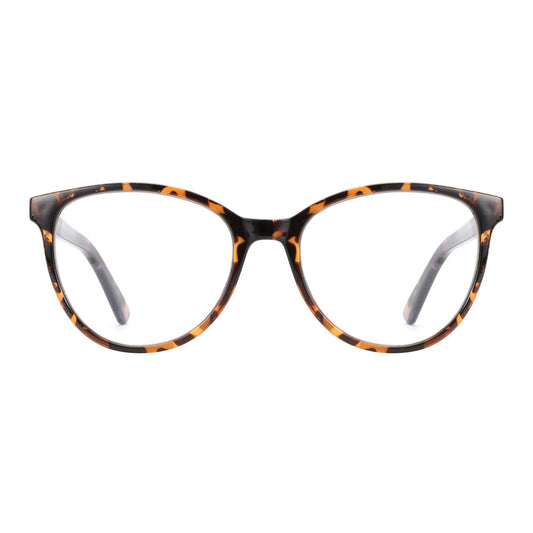
- Choose Thick Acetate Frames: Bold acetate designs naturally hide lens edges, making them the preferred choice for 2025's maximalist aesthetic.
- Mind the Effective Diameter (ED): Smaller ED measurements in oversized-looking frames help maintain optical clarity and reduce lens weight.
The Technical Challenge of Oversized Frames for High Prescriptions
For those with strong prescriptions, typically defined as +/- 4.00 diopters or higher, the physical laws of optics often clash with fashion trends. Myopic (nearsighted) lenses are thinnest at the center and thickest at the edges. Consequently, as the frame size increases, the lens edge becomes exponentially thicker. This not only adds significant weight, leading to discomfort and slipping, but also introduces "magnification" or "minification" effects that can distort the appearance of the wearer's eyes and face.
In 2025 and 2026, the trend toward "Technical Maximalism" has pushed manufacturers to innovate. We are seeing a shift toward frames that look oversized due to their thick rims and bold shapes but maintain a more conservative lens opening. Understanding how to navigate these dimensions is the key to a successful fit.
Logic Summary: These recommendations assume a standard pupillary distance (PD) and a prescription exceeding +/- 4.00. The guidance focuses on minimizing the "power-to-weight" ratio, which may be less critical for lower prescriptions where standard lenses suffice.
2025 Trends: The Rise of "Technical Maximalism"
The eyewear landscape in 2025 has been dominated by bold, geometric shapes and translucent acetates. This "maximalist" trend is actually a boon for high-prescription users if approached correctly. Thick acetate frames, a staple of current collections, provide a natural "buffer" that hides the thick edges of high-RX lenses.
When you browse our oversized sunglasses collection, you will notice that many of the most popular 2025 styles utilize "sculpted" acetate. This technique involves varying the thickness of the frame material, which can be strategically used to mask lens depth. Geometric shapes—hexagons and octagons—are also trending, offering a modern alternative to the classic round or square oversized look. These angular designs often allow for a larger overall frame width while keeping the actual lens height manageable, which is a significant technical advantage for lens surfacing.

The "Center-Pupil" Rule for Frame Selection
The most common mistake when choosing oversized frames for a strong prescription is ignoring the relationship between the wearer's Pupillary Distance (PD) and the frame's Optical Center. For the thinnest possible result, your pupil should be as close to the horizontal center of the lens as possible.
When a lens is "decentered" to align with your pupil in a frame that is too wide, the lab must use a larger lens blank, which results in much thicker edges on the outer side. To achieve the oversized look without the technical drawbacks, look for frames with a wider "bridge" (the distance between lenses) or extended "endpieces" (the parts that connect to the temples). This allows the frame to sit wider on your face while keeping the lenses themselves relatively small and centered. For more detailed advice on matching these technical needs with your aesthetic, see our guide on how to choose frames for your face shape.
Lens Material Selection: Beyond the Index
Selecting the right material is just as important as the frame. The industry has standardized around high-index polymers that offer superior refractive power with less mass. According to the technical guide to high-index lens materials, which details the MR™ series polymers and compliance with ANSI Z80.1-2025 standards, the choice between 1.67 and 1.74 index is often the difference between a lens that stays within the frame and one that protrudes significantly.
| Prescription Range | Recommended Index | Key Benefit | Trade-off |
|---|---|---|---|
| +/- 2.00 to +/- 4.00 | 1.61 High-Index | Balanced weight and cost | Standard thickness |
| +/- 4.00 to +/- 6.00 | 1.67 mid-index lenses as an alternative | 30% thinner than standard | Moderate chromatic aberration |
| Over +/- 6.00 | 1.74 high-index lenses for strong prescriptions | Thinnest possible profile | Higher cost; lower Abbe value |
Logic Summary: This table uses a "rule of thumb" based on average frame sizes (52-55mm). If choosing a truly "jumbo" frame (58mm+), we recommend moving up one index level regardless of the prescription to manage weight.
Essential Checklist for High-RX Oversized Shopping
Before finalizing your purchase, use this checklist to ensure your new 2025-trend frames will perform as well as they look:
- [ ] Check the Frame PD: Add the lens width and bridge width. This "Frame PD" should be within 2-4mm of your actual PD.
- [ ] Verify Frame Material: Opt for acetate over thin metal to better conceal lens edges.
- [ ] Review the Bridge Fit: Ensure the bridge is snug; oversized frames are heavier and require proper eyewear fit guidelines to stay in place.
- [ ] Select Aspheric Lenses: These lenses have a flatter profile, which is essential for reducing the "bulge" in large frames.
- [ ] Apply Anti-Reflective Coating: Larger lenses have more surface area for distracting reflections; a high-quality AR coating is non-negotiable.
Common Pitfalls: Why "Bigger" Isn't Always Better
While the 2025 aesthetic celebrates large silhouettes, there is a "point of diminishing returns" for high-prescription users. A frame that is too deep (vertically) can cause "floor tilt" or "swim" sensations due to peripheral distortion, especially in progressive lenses. Furthermore, extremely large lenses are more prone to "crazing" or cracking if the frame flexes, as the lens material is under more tension.
By choosing frames with a moderate vertical height (B-measurement) but a wider horizontal presence, you can capture the "oversized" vibe while maintaining the structural integrity and optical precision required for clear vision.
FAQ
Can I wear oversized aviators with a -8.00 prescription? While possible, it is generally not recommended because the classic "teardrop" shape of aviators creates a very large Effective Diameter (ED) at the bottom outer corner. This leads to extreme lens thickness and weight in that specific area. If you love the look, opt for a "modified aviator" with a more squared-off bottom and use 1.74 super high-index lenses to mitigate the thickness.
Do oversized frames make my eyes look smaller? Strong minus prescriptions (for nearsightedness) naturally have a minifying effect, making eyes appear smaller. Oversized frames can exaggerate this because there is more "empty space" around the eye within the lens area. To counter this, choose frames with bold colors or patterns that draw attention to the frame itself rather than the eye size, and ensure your pupils are perfectly centered.
What is the best frame material for hiding thick lenses in 2026? Thick-rimmed acetate remains the gold standard. In 2026, "laminated" acetate—where multiple layers of different colors are fused together—is particularly effective. A dark outer layer with a translucent inner layer can create an optical illusion that makes the frame appear thinner while still providing the depth needed to hide a 1.74 index lens edge.
Is there a limit to how big a frame can be for a high prescription? Technically, the limit is the size of the lens "blank" (the raw circular lens before it is cut). Most high-index blanks are 65mm to 75mm in diameter. If your PD is narrow and the frame is very wide, the lab might not be able to "reach" your pupil center within the blank. Always provide your PD to the retailer to verify compatibility before ordering jumbo frames.
How does vertex distance affect oversized glasses? Vertex distance is the space between the back of the lens and your eye. Oversized frames often sit closer to the face or further away depending on the bridge design. For high prescriptions, even a 1-2mm change in vertex distance can slightly alter the effective power of the lens. Ensuring a professional fit that maintains a consistent vertex distance is crucial for visual comfort in large frames.
Are geometric frames better than round frames for high RX? Geometric frames, such as hexagons, can be better because they often provide a "corner" that allows for a wider frame fit without increasing the overall lens area as much as a perfectly round frame would. This helps keep the lens weight down while still providing a trendy, oversized silhouette.
References
Government / Standards / Regulators
- ANSI Z80.1-2025: Ophthalmics - Prescription Ophthalmic Lenses - Recommendations
- ISO 8980-1:2017: Ophthalmic optics - Uncut finished spectacle lenses
Platform official docs & policies
Industry associations / research institutes / market reports
- The Vision Council: Eyewear Trends and Lens Technology Report 2025
- Optical Heritage Museum: Evolution of Lens Materials
