




How to Minimize 'Power Rings' in High Prescription Lenses
How to Minimize 'Power Rings' in High Prescription Lenses
Disclaimer: This guide provides aesthetic and material recommendations for eyewear. It is not a substitute for professional medical advice, diagnosis, or treatment from a licensed optometrist or ophthalmologist. For complex prescription needs, always consult with your eye care professional.
Summary
Minimizing 'power rings' in high prescription lenses requires a strategic combination of high-index materials, thoughtful frame selection, and precise lens finishing. By opting for 1.74 high-index lenses and smaller, rounded frames with thicker rims, you can typically reduce the visibility of concentric reflections and edge thickness, resulting in a more aesthetic and lightweight pair of glasses.

Key Takeaways
- High-Index Materials: Upgrading to 1.74 high-index lenses can reduce edge thickness by an estimated 25% to 35% compared to standard 1.50 plastic, depending on the lens diameter and frame shape.
- Frame Geometry: Smaller, rounded frames are generally more effective than large or rectangular shapes because they allow the lab to cut away the thickest outer edges of the lens blank.
- Edge Treatments: Satin or matte edge finishes are often preferred over high polishing for high-minus prescriptions to help diffuse the "glow" and internal reflections that create the ring effect.
- Vertex Distance: Minimizing the distance between the lens and your eye (vertex distance) can help reduce the apparent magnification of the lens edges to an observer.
Understanding the Physics of Power Rings in High-Minus Lenses
For those with high myopia (nearsightedness), lenses are thin in the center and thick at the edges. This concave shape is necessary to diverge light correctly onto the retina, but it creates an optical phenomenon known as 'power rings.' These are the concentric white circles visible near the perimeter of the lens, caused by internal reflections between the front and back surfaces, as well as reflections from the lens edge itself.
As prescription strength increases, edge thickness grows, providing more surface area for these reflections. This is why a -8.00D lens typically exhibits more noticeable rings than a -2.00D lens. While modern manufacturing standards like ANSI Z80.1-2025 ensure high precision, the fundamental physics of light reflection remains a challenge for high-prescription users.
Expert Insight: Power rings are an inherent optical byproduct of high-minus lens geometry. While they cannot be entirely eliminated due to the laws of physics, their visibility is a variable that can be managed through material science and frame styling.
The Role of High-Index Materials in Reducing Edge Reflections
Selecting a lens material with a high refractive index is one of the most effective ways to combat power rings. The refractive index measures how efficiently a material bends light; the higher the index, the less material is required to achieve the same prescription power.
When you choose 1.74 high-index lenses, you are using the thinnest plastic material currently available. By reducing the physical thickness of the edge, you effectively shrink the "mirror" that creates the power rings.
Comparative Lens Thickness (Estimated)
To help visualize the impact of material choice, the table below shows the approximate reduction in edge thickness for a typical -6.00D lens (based on a standard 50mm lens diameter):
| Lens Material (Index) | Estimated Edge Thickness | Aesthetic Impact on Power Rings |
|---|---|---|
| Standard Plastic (1.50) | 100% (Baseline) | Most prominent rings |
| Polycarbonate (1.59) | ~20% Thinner | Noticeable reduction |
| High-Index (1.67) | ~30% Thinner | Significant reduction |
| Ultra High-Index (1.74) | ~35% Thinner | Maximum reduction available |
Note: Actual thickness varies based on specific prescription, pupillary distance, and frame dimensions. For a deeper dive into these trade-offs, see our 1.67 vs 1.74 high-index lenses comparison guide.

Strategic Frame Selection: Size and Shape Matter
The frame you choose plays a role nearly as significant as the lens material. Optical labs start with a circular "lens blank" and cut it to fit your frame. Because minus lenses are thickest at the outer edges, a larger frame will inevitably retain more of that thickness.
Why Small and Round is Generally Better
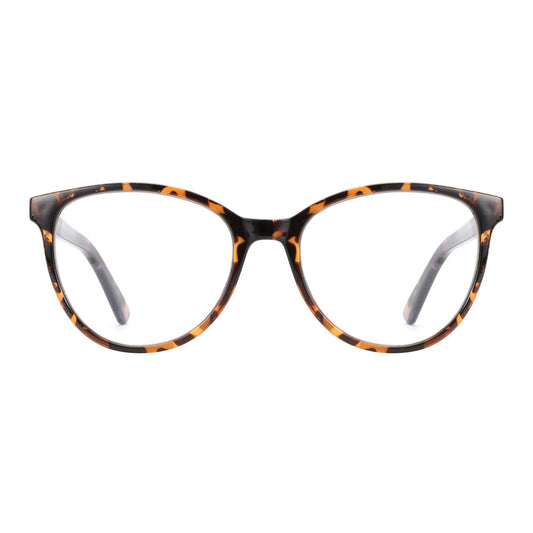
Round and oval frames are naturally better at hiding power rings than rectangular or square frames. In a rectangular frame, the distance from the optical center to the corners is much greater than the distance to the top or bottom. This means the thickest part of the lens is preserved in the corners. A rounder shape allows for a more even distribution of edge thickness and removes the most problematic areas of the lens blank.
The Advantage of Thicker Rims
Frames made from acetate or other thick-rimmed materials are excellent for high prescriptions. The rim acts as a physical shroud, covering the edge of the lens and blocking the side-view reflections. Conversely, rimless glasses are often discouraged for high-minus prescriptions, as they leave the entire thick edge exposed, maximizing the visibility of concentric rings.
| Feature | Recommended for High Minus | Why it Helps |
|---|---|---|
| Eye Size | Small (46mm - 50mm) | Minimizes the amount of thick edge retained. |
| Shape | Round or Oval | Avoids thick corners found in rectangles. |
| Material | Thick Acetate | Conceals the lens edge from side angles. |
| Bridge Fit | Precise (Matches PD) | Ensures the eye is centered, minimizing decentration thickness. |
Advanced Edge Treatments and Finishing Techniques
The way the edge of your lens is finished can change how light interacts with it. While a "high polish" makes the edge look clear, it can also act like a fiber-optic cable, carrying light around the perimeter and making power rings appear brighter.
Many opticians recommend a satin or matte finish instead. This diffuses the light hitting the edge, making the thickness less noticeable. Another technique is the "roll and polish," where the sharp back edge of a thick lens is beveled to reduce its profile. However, this can sometimes create its own reflections, so it should be discussed with your optician based on your specific frame choice.
The Impact of Vertex Distance and Pupillary Distance
The technical fit of your glasses is the final piece of the puzzle. Vertex distance is the space between the back of the lens and your cornea. The further the lens sits from your eye, the more the edges are magnified to an observer. Choosing a frame that sits closer to your face can minimize the apparent size of the power rings.
Furthermore, your Pupillary Distance (PD) is vital. If the frame's optical center does not align with your pupils, the lab must "decenter" the lens. Decentration adds thickness to one side of the lens, which can exacerbate power rings. For more on these technical requirements, refer to our Technical Guide to High-Index Lens Materials and Standards.
FAQ
What exactly are power rings in glasses? Power rings are concentric white circles visible at the edges of high-minus lenses. They are caused by internal reflections of light between the lens surfaces, which become more pronounced as the lens edge gets thicker.
Can 1.74 high-index lenses completely remove power rings? No, 1.74 lenses cannot completely remove power rings because they are a result of the lens's concave geometry. However, because they are significantly thinner than standard materials, they can substantially reduce the surface area where these reflections occur.
Why do my power rings look worse in rectangular frames? Rectangular frames have corners that are further from the optical center. Since minus lenses get thicker as you move away from the center, these corners house the thickest part of the lens, making rings more prominent.
Should I get my lens edges polished if I have a high prescription? While polishing makes the edge clear, it can increase the visibility of power rings by allowing more light to reflect internally. A satin or matte finish is often recommended to diffuse light and help the edge blend in more naturally.
Does an anti-reflective (AR) coating help with power rings? Yes. AR coatings reduce the amount of light reflecting off the lens surfaces, which helps dampen the intensity of the internal reflections that create power rings. Most 1.74 lenses include advanced AR coatings as a standard feature.
References
Government / Standards / Regulators
- ANSI Z80.1-2025: Ophthalmics - Prescription Ophthalmic Lenses - Recommendations (American National Standards Institute)
- ISO 8980-1:2023: Ophthalmic optics - Uncut finished spectacle lenses (International Organization for Standardization)
Industry Associations / Research Institutes
- The Vision Council: Ophthalmic Lens Selection and Fitting Standards
- American Optometric Association (AOA): Clinical Guidance on High Myopia Correction
Platform Official Docs & Policies
- Technical Guide to High-Index Lens Materials and Standards (Zenottic Authoritative Guide)
