


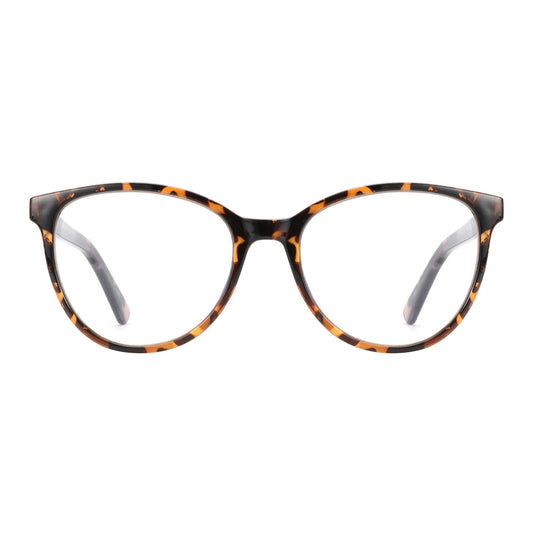

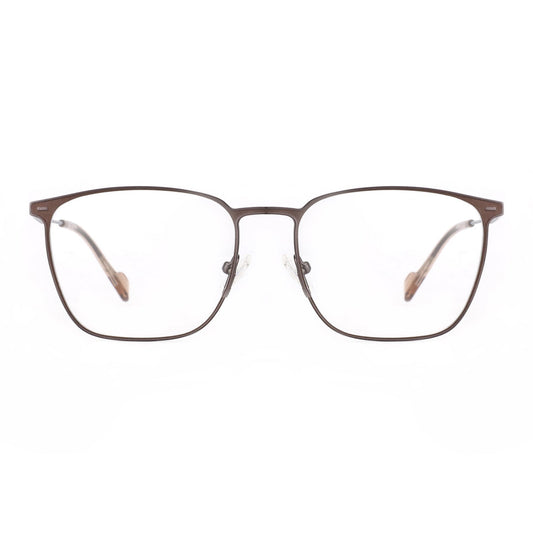
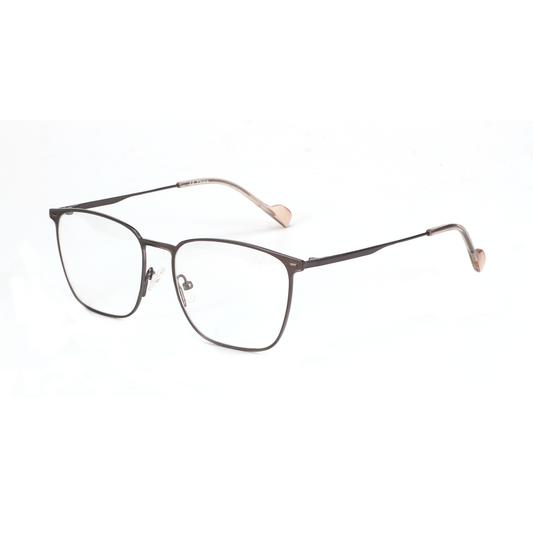
How to Choose Frames for a Strong Plus Prescription
The best plus prescription frames for a strong farsighted prescription usually have a modest lens opening, place your pupils close to the center of each lens, and fit your face comfortably. Plus lenses are thickest in the middle, so these three factors shape how bulky the finished lenses look and feel. No frame style guarantees a thin result, so have the exact frame and prescription checked together before you order.
Which frame features matter most for a strong plus prescription?
Two measurements matter more than any style label: the size of the lens opening and where your eyes sit inside it, along with a comfortable fit. Use these checks when comparing eyeglasses.
Start with the actual lens opening
A plus lens is convex, so it bulges out in the middle and tapers toward the edges. Industry training material in Eyecare Business's lens thickness basics notes that plus lenses are thickest at the optical center. It also explains that a larger frame needs a larger lens blank, and a larger lens diameter means a thicker lens. For a strong plus prescription, that added center thickness can make lenses look heavy and magnified.
That's why you should compare the lens opening itself, not the frame's overall width or a name like "petite" or "oversized." Two frames with similar total widths can have very different lens sizes if their bridges or end pieces differ. A compact opening is a good place to start your search, though it still has to fit your face and line up with your eyes—a tiny frame that fits poorly can cause its own problems.
Shape advice is often written for minus lenses, which are thickest at the edges. Our guide to angular frames and edge thickness covers how that differs. For plus lenses, no single shape is proven best. Judge each frame by its actual opening and how it centers your eyes.
Pay attention to where your eyes sit
Your pupillary distance (PD) is the distance between the centers of your pupils. Each frame also has a "frame PD," which is the distance between the centers of its two lenses. When these numbers differ, the lab has to shift each lens's optical center away from the middle of the opening. This shift is called decentration.
Decentration matters a lot for strong plus lenses. In plus lenses, decentration can increase thickness at the optical center and nasal edge, as The Vision Council's dispensing guide explains. A frame whose lens centers sit close to your pupils is often the simplest way to keep lenses from getting thicker than they need to be.
How can you compare a specific frame before ordering?
Once you have a few frames in mind, check them the same way. Write down the measurements, compare them with your PD, and look at how each frame sits on your face.

Compare the opening, eye position, and fit
Most frames list three numbers, such as 50-20-145. The first is the lens width (A), the second is the bridge width (DBL), and the third is the temple length. Add the lens width and bridge width to get the frame PD. For example, a 50-20 frame has a frame PD of 70 mm.
| Feature | What to record or ask | What it helps determine |
|---|---|---|
| Lens opening and outline | Lens width (A), lens height, overall shape | How large a lens blank the frame may need |
| Frame PD vs. your PD | A + DBL compared with your measured PD | How far the lenses must be decentered |
| On-face fit | Bridge comfort, temple length, eyes centered in each lens | Whether the frame sits correctly and stays put |

According to The Vision Council's dispensing guide, the bigger the gap between frame PD and your PD, the more decentration you get. In plus lenses, that adds thickness at the center and the nasal (nose-side) edge. The guide's advice is to choose a frame with lens centers close to your PD.
Fit is just as important. The 20/20 Magazine fit and dispensing course, which received educational-grant support from Signet Armorlite/Kodak Lens, lists three checks for a good fit: the width should center your eyes, the bridge should rest comfortably on your nose, and the temples shouldn't be too long, too short, too tight, or too loose. A frame that is too wide pushes your eyes toward the bridge, which adds extra thickness at the nasal edge with plus lenses. A frame that is too narrow pushes your eyes toward the temples, which can hurt central vision and also add thickness.
Use this table to narrow your list, not to predict how thick your lenses will be. It tells you which frames are worth a closer look. For a deeper explanation, see our article on frame size and lens decentration.
Confirm the exact combination before ordering
Bring your current prescription and your top frame choice, or its full measurements, to an optician or dispensing lab before the lenses are made. Ask three things:
- How will this frame's measurements and my PD affect where the lens centers go?
- What center thickness and look should I expect with the lens options you suggest?
- Could the lens thickness get in the way of adjusting the nose pads or folding the temples?
That last question is a real concern. The 20/20 guide notes that a high-powered lens can be decentered so much that the extra thickness affects nose pad adjustment or even stops the temples from closing. If you don't know a frame's measurements or your PD, ask what the professional needs instead of guessing.
How should lens material affect your frame choice?
Choose your frame on fit and measurements first. Then compare lens materials for that exact frame and prescription.
Compare lens options for this prescription and frame
Eyecare Business's lens material guidance notes that for a high prescription, a higher-index material can reduce lens thickness and weight. The same source treats frame size and decentration as separate thickness factors. Therefore, a higher-index lens can't fully make up for an oversized opening or poorly centered eyes.
Ask your optician which materials and lens designs they would suggest for your prescription in the frame you picked, and how the expected thickness and weight compare. Don't choose based on the index number alone. Your next step is simple: pick one or two frames that pass the table check, then have them reviewed with your prescription before you buy lenses.
FAQs
Are small frames always better for a strong plus prescription?
No. A smaller lens opening can mean a smaller lens blank and less center thickness. Even so, the frame still has to center your eyes and fit your nose and ears comfortably. A small frame that is too narrow for your face can push your eyes toward the temples and add thickness.
How do I find a frame's PD?
Add the lens width to the bridge width. These are usually the first two numbers printed on the inside of the temple arm or listed on the product page. Compare that total with your measured PD. A closer match generally means less decentration.
Is there a frame shape that works best for farsighted lenses?
Existing guidance doesn't support a single best shape for strong plus lenses. Look at the actual lens opening and how well the frame centers your eyes, not the shape category.
Can high-index lenses fix a frame that is too big?
Not fully. Higher-index material can reduce thickness and weight for a high prescription, but frame size and decentration still affect the result. Have the specific frame and lens options assessed together.
